
Today I’m breaking from my typical pattern of talking about my experiences in designing games to tell a story about helping someone else figure out how to teach an existing game (or category of games, anyway). There’s still some game design in it, but mostly it’s about figuring out pivots to make something work within limitations that the game doesn’t typically have.
My son is a Scout. As in, “member of the organization formerly known as Boy Scouts, now Scouting America”. I was a Scout too, and almost 40 years later, it’s pretty fascinating to watch him jump head-first into his troop’s program.
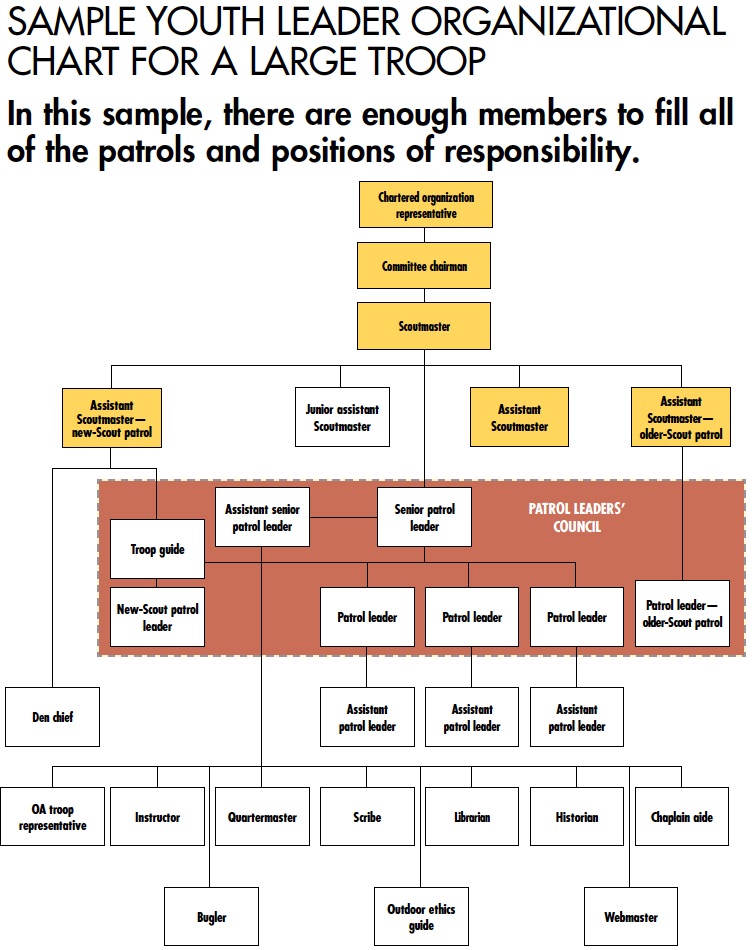
He started in February of this year, graduating up from a phenomenal local Cub Scout pack. Within two months, he’d been elected to the role of Assistant Patrol Leader — basically the backup/support role for the youth leader of a small subset of boys in the troop. With that new role came a commitment to participate in the troop’s monthly Patrol Leaders Council, a youth-led group within the troop that plans meetings and outings. Together, they decide what their bigger weekly Scout meetings are about.
It didn’t take long for him to volunteer to lead a meeting… or to mix one of his other big interests into the plan.
“I’d like to run a D&D campaign for the scouts”, he announced.
The other scouts were curious. It was something well outside their typical meeting topics. They took a vote. It passed nearly unanimously.
They got an adult leader within the troop, John (who happens to also be a huge tabletop gaming fan), to volunteer as a co-lead for the meeting. As Scouting America is structured, this is essentially a support role, giving the youth lead (my son) nearly all the reigns on the program for that meeting. It was up to my 11-year-old to figure out how to make a meeting about Role Playing Games happen.
On the drive home, I asked him to think about practical logistics. He was absolutely buzzing with excitement about running his fellow Scouts through an epic adventure of his own creation. He hadn’t really thought about how that would work yet.
“How many scouts will be there?”, I asked.
“I don’t know, maybe 15?”
“Okay,” I replied, “That’s a pretty big party. How much time will you have?”
“Half an hour to 40 minutes”, he answered.
“Not much time. How about characters? Are you going to make a bunch of characters ahead of the meeting, or will they make their own? How long would that take?”
Per the way Scouts works, it’s up to him to figure out the solutions to all these questions within the three-odd weeks before the date of the meeting. Per the way I know his enthusiastic, ambitious 11-year-old brain works, it’s up to me to ask him more questions to help him focus on a plan.
He quickly did the math, and figured out that his party of 15 players would probably be more manageable and fun if it were instead three parties of about 5 adventurers. That meant he’d need to wrangle in two more Scouts to oversee the other parties. Not difficult, as it turned out.
The next puzzle was that of creating characters. Traditionally, at least with Dungeons & Dragons, character creation can take over an hour, depending on how deep you want to get into it. It’s an adventure all to itself in rolling dice, consulting tables and charts, picking attributes, crafting backstory, and so on. If there’s a downside, that’s it right there. The upside though is that it’s all actually a lot of fun. Definitely more fun than just grabbing a pre-made character, though pre-made characters certainly let you get to adventuring faster.
He wanted to maximize the fun, but also get that part of the meeting done FAST, so they could get into the adventures and have time to see what happens in that part of the game. He needed to find a way to streamline the process.
I asked him what was more important to him: rolling dice for randomly generated character elements, or just having lists of character attributes to pick from. He chose the latter.
“How do you want to present those character attributes?”, I asked.
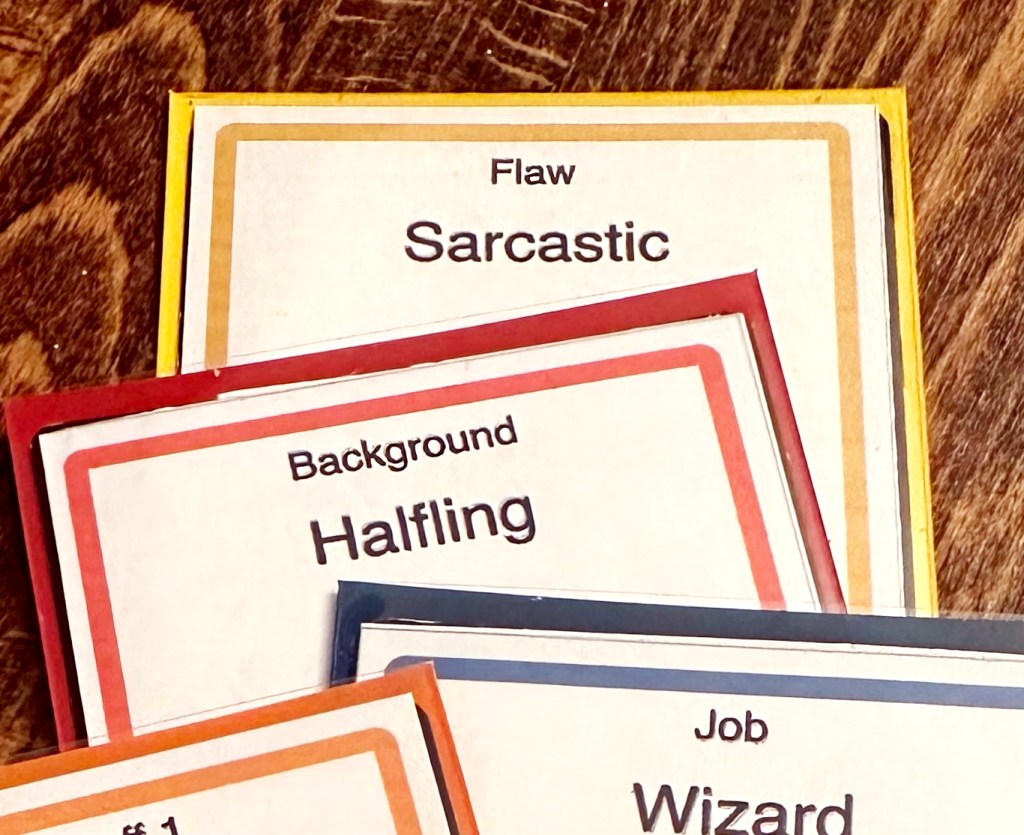
He suggested we put them on cards and let people choose the things they liked. I myself really liked this idea, because it helped keep things mostly on a set of rails, and for the limited time he had to prepare for and lead the demonstration, rails would be very helpful.
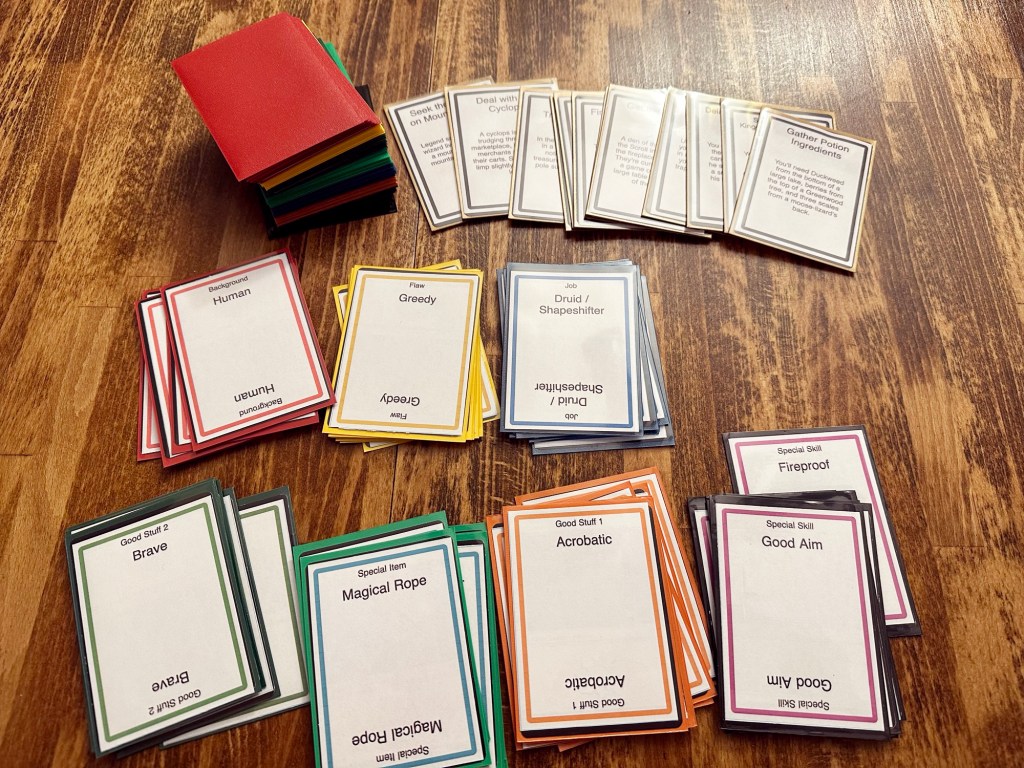
“Do you want to have people taking turns picking from the cards, or do you want to draft them, like in Bunny Kingdom?” (I’d have usually cited something like Sushi Go, but he knows Bunny Kingdom better.)
He chose simultaneous drafting. He saw that he could get more options in front of the other scouts in a more compact time, with fewer options to consider all at once. I think this was a really solid choice for his goals.
The other big part of the meeting would be the adventure the scouts would play through. We talked a lot about this, and he eventually decided to do a little more streamlining, taking the dice out of the game and skewing it more into collaborative improvisational storytelling, which is generally the real heart of RPGs. The Dungeon Master for each group would mostly just be there to help the party tell a relatively cohesive story based on some short (also on cards) quest prompts.
He ran his plan past the adult leader, John. We all talked about what sorts of Scouting values the whole demonstration would be about: cooperation and communication were right there, as were creativity and problem solving. My son was pretty proud of how apropos all of this was to Scouting (even if he hadn’t really thought about it that way beforehand).
Now for the execution of the plan, starting with production of his cards. It helps a lot that I have the background and tools available to speed this all up and build the prototype with him.
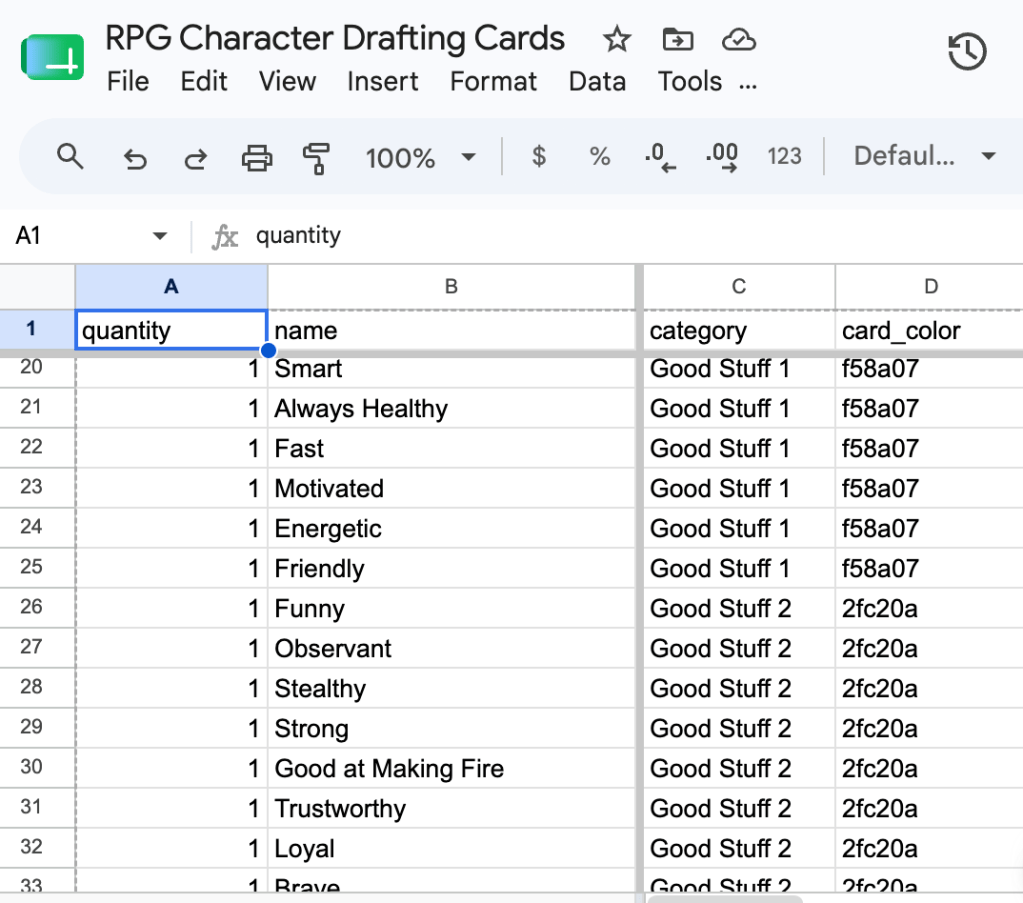
I’ve written before about Component Studio 3 and its usefulness in making decks of cards. The backbone of it all is simple spreadsheets, which my son can absolutely handle with minimal guidance. Once I’d formatted the columns in the way that Component Studio processes everything, I cut him loose to fill in the card categories with character elements.
We divided his attributes into seven coulmns:
- Background (we avoided the term “race”)
- Job (Class)
- “Good Stuff 1”
- “Good Stuff 2”
- Flaw
- Special Skill
- Personal Item
I suggested he aim for eight things in each column so that a sub-group of 4 to 6 scouts would always have meaningful choices, even at the end of the draft picks. Quickly, he went right to work filling in the cells of the Google sheet.
In one of his most inspired moments of the entire project, he decided to base a lot of his attributes on things the scouts would intrinsically know. Many of his “Good Stuff” attributes were personality traits that came directly from the Scout Oath and Scout Law. A Scout is Trustworth, Loyal, Helpful, Friendly (and more), and their characters could be too. Under Special Skills, he put a few more Scouting-related abilities. And under Personal Item, nearly all of them were “magically-themed” analogs to camping gear.
I was really impressed.
I gave the cards some really basic design formatting and printed out a set for us to make the first prototype. I helped him cut and sleeve all the cards, and at his next meeting — the one a week before the final presentation — he was able to test the drafting out with some of his friends.
It only took him a few minutes to teach five or six other scouts how it would all work. One of the others he’d recruited to help run the adventure sessions pulled out a stopwatch to see just how much time they should expect to commit to this part of their meeting. Roughly three and a half minutes later, six scouts each had a character that they’d had actual agency in crafting. Each beamed as they told the others what their Elf Barbarian / Halfling Thief / Orc Healer was like. And then they all asked to do it all over again.
My kid had made a hit. All signs pointed to the next week’s demo being a big success.
The next piece was the adventures. He knew he needed a bunch of small prompts that would be easy for the adventure parties to improv their stories around. He already had a bunch that he’d extracted from the larger campaign he’d initially wanted to run, and I found a website that generated randomized one-sentence story prompts to fill in the rest of the list. I helped him work some of the character elements from the main decks into the stories so that there were a few obvious hooks between the characters and their adventure goals. Then, back to spreadsheets and Component Studio 3 we went.
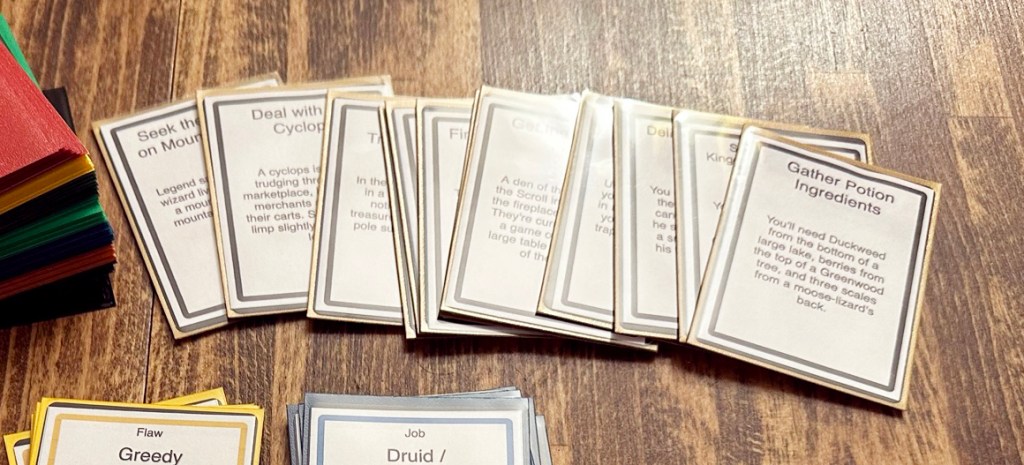
These cards allowed him to shuffle up the stories and give a handful to each of the youth leaders at the final meeting. While they weren’t a full adventure and didn’t come with a ton of details, the hope was that they would serve as enough of a starter for the teams of scouts to build some interesting tales around quickly. There was no real right or wrong way for the parties to solve their situations, it was all about just working together to tell a story they could each contribute to.
The troop’s “RPG Demo” scout meeting was last night. 21 scouts showed up for it, six more than he’d ever anticipated or planned for. I’m glad we made him three sets of cards for the demos, and that there were just enough attribute cards for all the kids to make a character with. One of his volunteer Dungeon Masters even printed up and brought sheets of magical item lists he’d found in one of his own RPG guidebooks to share with the scouts. They needed rewards for their adventures, after all.
Beyond that, I honestly don’t know too much about how it went, other than I heard a lot of non-specific excited chatter from the scouts on their way out of the meeting. Most of the parents, myself included, had gotten pulled into a separate meeting about the processes for earning Merit Badges and rank advancements, followed by another prep meeting for the parents of first-time summer-campers.
My son was really proud of his demos though, and seemed very satisfied that everyone had had fun. I still haven’t heard any of the adventure stories his own group crafted, and given how quickly he moves on to other things daily, I’ll probably have to extract that information via some light High/Low/Buffalo interrogation. There could even be a follow-up post here soon to share a tale or two.
Yeah, I know I’m pretty hit-or-miss on the follow up posts. I need to get better at that. This one seems like it could be pretty easy though. And fun. We’ll see.
 DiscoCandybar.com
Leave a comment