
I seem to do this every few months: I post a whole bunch of content here for several weeks, then go dormant for a prolonged stretch. I need to get better at this. I also promised you a follow up to the Easter Puzzle Hunt/Escape Room I made for my son… and, well, I don’t have much for you there either. He had a lot of fun, it all took him about an hour, and we’ll probably do it again next year.
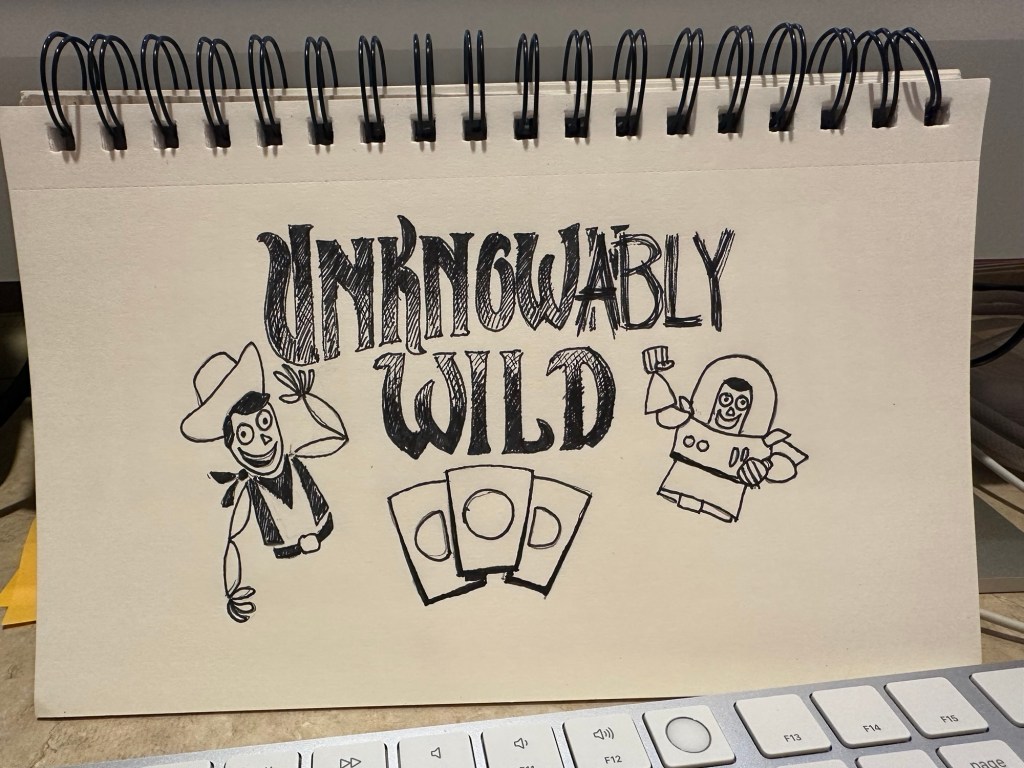
What I DO have this time is a bit of a rare opportunity. See, the Wilds Unknown set for Lorcana debuts at prerelease events today. I was the lead designer on that set, so it’s exciting to finally get to crack open packs of something I had a strong hand in shaping, and to see players getting to experience the themes and mechanics we built into the cards — and set as a whole.
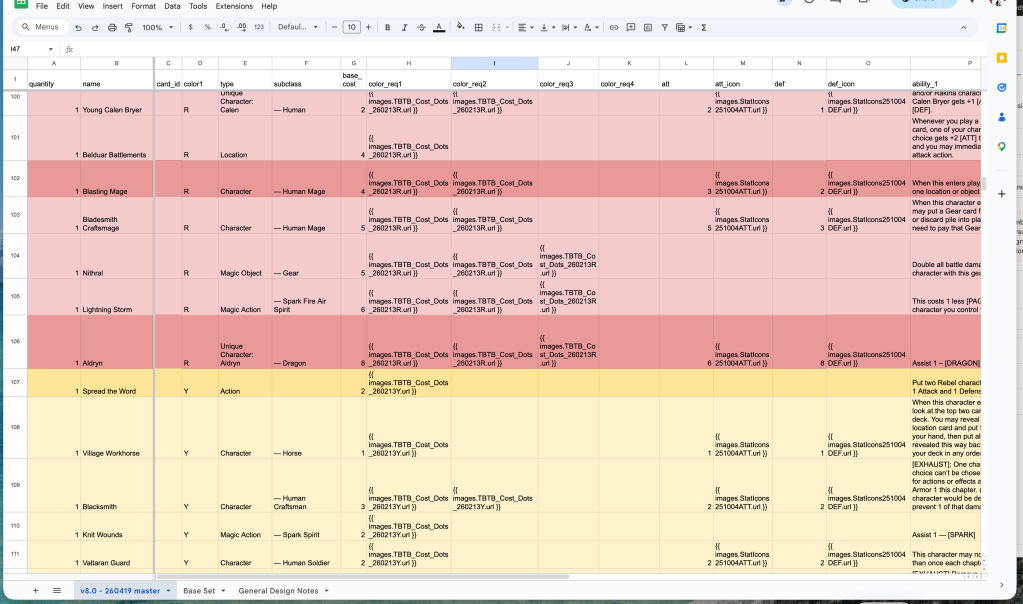
I’ve also mentioned in previous posts that I’m working on an independently produced Trading Card Game based on Ryan Cahill’s The Bound and the Broken novels. We’ve reached the stage in design where we know how the game works and what the rules and play patterns are all about, and now we start populating spreadsheets with individual cards.
The timing of these things intersecting tells me that if I’m ever going to write about designing a Trading Card Game with strong, identifiable mechanical themes, now is when it should happen.
Before I get too deep in the stories, I should give a few notes about my relationship with the Lorcana set. I was once an employee of Ravensburger, but haven’t been for a little over a year now. I’m no longer a representative of their Game design team, and have no business ties to their Brand or Marketing teams. Generally speaking, Ravensburger tends to keep a lot of their game design process for Lorcana behind a proverbial curtain, and I intend to respect that. I won’t be talking here today about the design of specific cards, or even themes, in any of the sets I created for them.
What I WILL be talking about is my philosophy of TCG set design in a general, holistic sense. If I do this right, you’ll be able to see how my process was applied to the structure and themes of both Wilds Unknown and the upcoming first set for The Bound and the Broken TCG.
So here we go!
I’ve talked in the past about how many games, especially TCGs, benefit from using a “color pie” as a central structural element. This is basically a way to put different mechanics and themes into columns that push players towards making decisions about their strategy. If, as a player, you’re given access to ALL the tools and strategies in the game, you’ll often be able to “solve” the game by just doing whatever is the ultimate optimal thing in any moment. If you only have access to SOME of the tools though, you have to make choices both before the game starts and during the game as to what strategies you want to focus on, and what weaknesses you’re willing to accept.
The latter makes decisions more meaningful, and games infinitely more interesting.
Depending on how many different colors your game puts into the pie, you’re going to see different ways you can use them to build a “mechanics/themes map”. Magic: the Gathering uses a five-color system, which maps out to 10 different pairs of colors, and 10 different three-color groups.
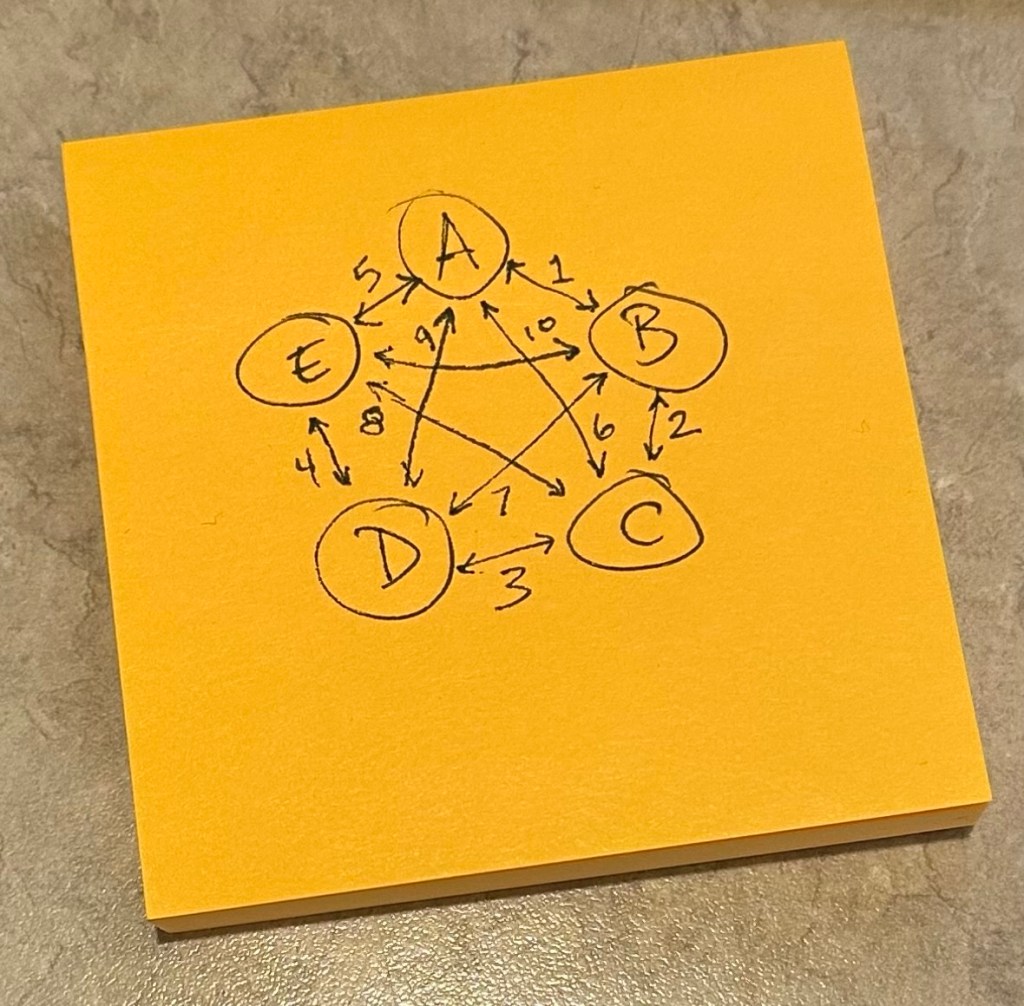
The 10 possible pairs in a five-color system
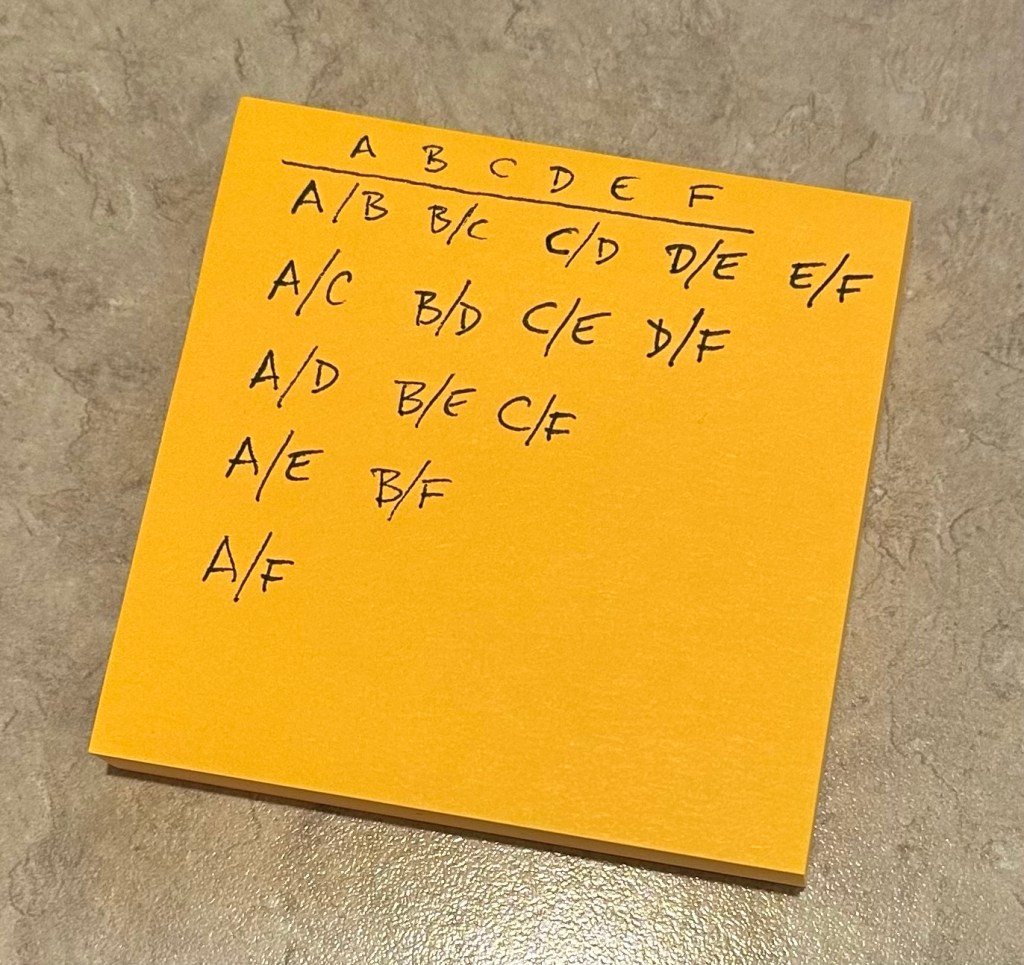
The 15 possible pairs in a six-color system
With a game using six colors, like The Bound and The Broken (or TBTB), the number of color pairs expands to 15. There are 20 distinct three-color groups in these games. Depending on the rules of the game — say, like in Lorcana, your core rules for constructing decks only allow you to put two chosen colors in any given deck — these three-color groups become less directly relevant. They’re still very useful in figuring out placement for mechanical themes in a set though; I’ll get back to that later.
For me, one of the most interesting things about these pairs and “triplets” is the way they can guide a player to understand and digest a large set of cards faster. Getting to know 200 to 240 cards all at once can be overwhelming. Breaking that list into 10-15 smaller lists of twelve to twenty cards at a time gives the reader a little space to take breaks and breathe. Parsing the smaller lists gets even easier if there’s a discernible theme to why those cards belong together, beyond just their common colors. The groupings become archetypes; distinct ways to approach and connect with the game.
Generally speaking, one of the primary features of any TCG is high modularity, with as many cross-compatible cards as possible. In a game system like this, the single-color cards — often referred to as “mono-<color>” — are inherently the most versatile when it comes to the number of decks they fit into. In a game where you can only play two colors at a time, the two-color cards will only ever be able to go into a single paired deck. That’s not to say you couldn’t make two different red-and-green decks do different things through specific selections of individual cards, just that there are fewer broad-form decks that those two-color cards can go in, making them less flexible in their utility.
In the design files for TBTB, there are 243 cards, with sub-lists dedicated for single-color cards and two-color cards. We don’t have a specific rule restricting players to a set number of colors in their decks, but there are definitely systems in place to prevent players from just playing all the most powerful cards from all six colors (that’s a post for another day). Realistically speaking, a deck can support up to three colors consistently, with the power levels of those colors shifting from build to build.
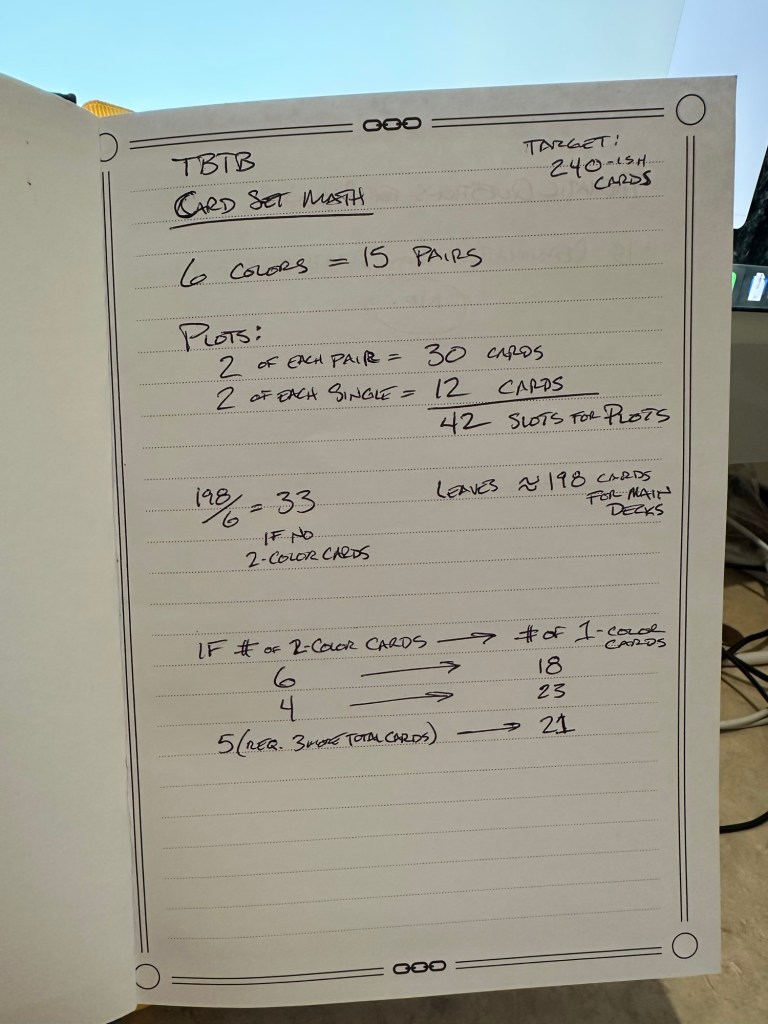
When I started mapping out how many cards would go in each of TBTB’s six colors, I went in knowing that we liked the idea of having two-color cards be a feature. For whatever reason, they’re fun for players to open in packs, but they’re also very useful in showing players right away what the mechanical themes are for any given color pair.
If I open a mono-yellow card that’s all about me playing “weapon” cards in my deck, that’s great, I have a signal or “signpost”: I can optimize this card by playing a bunch of weapons. Alone though, it doesn’t show me the full picture that this set might contain an entire group of cards that are equally as optimizable when I play a bunch of weapons. But if I open a yellow-AND-red two-color card that cares about weapons, I can be fairly sure that there are also going to be mono-yellow and mono-red cards that want weapons in the deck. I now know not only what kinds of cards to put together, but also which colors I’m likely to find the most compatible cards in.
This is especially relevant when it comes to game systems that don’t have color restrictions in the deckbuilding rules, as it gives players strong guidance as to why they should leave certain colors out of their deck. If the majority of the available slots in their build are already dedicated to the “weapons matter” cards, then there are naturally fewer slots available for cards that don’t care about weapons. If green, gray, purple, and black don’t care strongly about weapons the way the subset of yellow and red cards do, there’s less incentive to color outside the lines, so to speak.
Fifteen possible color pairs. Fifteen possible themes or archetypes. Fifteen times the number of cards in each of those two-color pairs, and now we start to see a lot of slots in the spreadsheet starting to fill up.
The balancing act is this: a two-color card tells us very quickly what a color pair’s theme is, but for every two two-color cards we put in the set in each pair, that eats up three slots for cards in each of the six individual colors. And as I mentioned earlier, it’s the mono-color cards that are inherently the most versatile when it comes to filling slots in deck construction.
I proposed to the TBTB team that, out of our 243 card set, we have seven two-color cards in each of the 15 pairs. This multiplies out to 105 multi-color cards, plenty to show players what the different themes are. This left us 138 slots for mono-color cards, which in turn meant that each of the six colors would have 23 cards. Some of those cards would be designed to best fit into one specific deck archetype, but by their nature as mono-color cards, there would be a fairly low barrier to playing them alongside other cards of the same color, regardless of deck theme.
That’s a whole lot of math to say “I feel good about the balance of mono- and multi-color cards in TBTB”. Players will be able to see the strong themes in various color pairs, and still have an open enough space to explore variances in the decks they build.
So lets say fifteen archetypes, defined by color pairs, is just too many for your audience’s preferences. How do we lower the number of recognizable archetypes, while maintaining a relative balance of themes across colors?
Well, to start, let’s open up the palette a little. In Lorcana, “limited” formats that don’t require players to build a deck before the event, players are allowed to run as many colors ad they’d like in their decks. This means that if an archetype lives in three or more colors, players will be able to see the themes more readily, especially if there are fewer archetypes competing for card slots in the overall set.
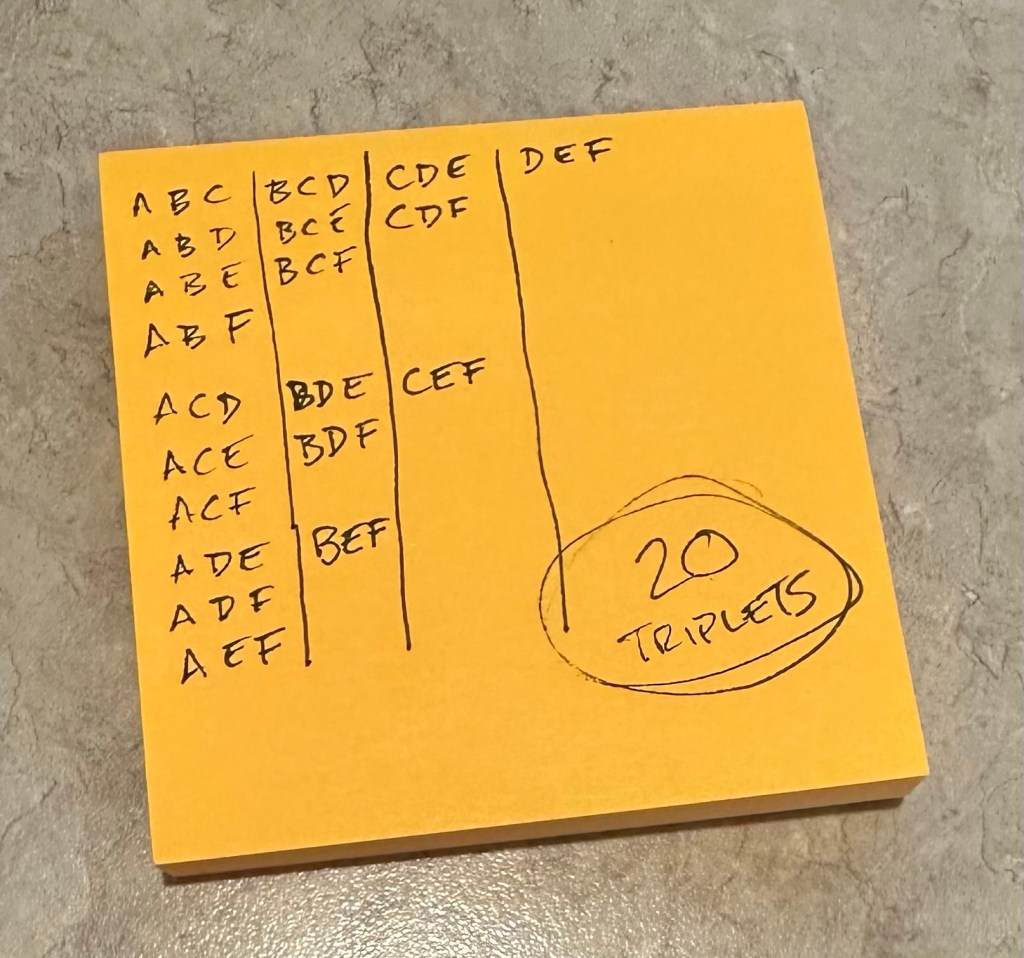
Triplets. There are 20 of them in a six-color system. Five more than the 15 pairs, and 15 was too many. Luckily, the math works out that you can keep your card distribution evenly balanced across six colors if we carefully choose to include only six of the triplets. Six is a nice, easy number for people to track. Six also happens to be a decent number of IPs to spotlight in a Lorcana set, and IPs make for great signals about grouping cards to get good, mechanically thematic synergies in the cards you select for a deck.
If you wanted to show players, “here’s a deck about healing, and a different deck about specific stats on your cards mattering, and another that wants you to fill your discard pile”, then building those themes into cards that could also be grouped by IP is a strong way to communicate those themes. You read me? You might find themes and groupings structured like that in TCG sets that I’ve built.
Looking at the open-field, no color restrictions world of limited-format Lorcana again, one of the challenges to making a set draft well is that anything goes. There’s nothing to stop a player from figuring out a ranked list of cards in the entire set, then just taking the mathematically best card that’s passed to them in any pack. Yes, it’s a simplification — there are a lot of factors that make some cards situationally better than others as you make your picks — but it’s one that holds true more often than not. Infusing strong archetypes into that environment widens the situational deltas between the cards you pick and the cards you pass.
In other words, I might be willing to pass the statistically best remaining card in a pack if a slightly weaker card has better synergies with a wider range of cards I’ve already picked. The visibility of archetypes means that there will be more variance and distinction between different players’ decks in the same draft pod, rather than six homogenized versions of “six-color good stuff”.
Six three-color archetypes is good for limited. But in a game where you’re only allowed to play two different colors at once in the most popular formats (constructed), what are we supposed to do with the cards in the third color that we can’t play?
As the meme goes, “That’s the beauty. You don’t play them.”
I said near the start here that the restrictions on playable colors is all about making meaningful decisions before the game even begins. If you like a mechanical theme of a set and want to expand that out to a full constructed deck, you can absolutely do that. You’ll just have to decide which two colors to focus on, and that’s a meaningful decision.
Say you like the way the healing-themed cards work in the Unknowably Wild set of Unspecified TCG. If each color has an underlying set of mechanics and themes of their own, then a healing deck made with colors <A and B> will see the big picture in a different way than the healing deck with colors <B and C> or <C and A>. You now have three distinctly different healing decks you can play, without leaving the familiar embrace of one of the six major set archetypes. Choose wisely.




As for TBTB and its 15 possible pairs, I’ll be the first to admit that, in planning, about 10 of those pairs have stronger themes than the other 5. That’s fine. The remaining 5 pairs are still playable and have interesting synergies all their own. They’re just not as deeply attuned to specific storylines and factions from the books. Are they still fun to play? That’s definitely the plan.
ANYHOW.
I’m heading out to play with the new Lorcana set very shortly. Let me know if you get a chance to play it too, and especially if you draft it. If memory serves from my days in R&D, it’s really good for that.


Leave a comment