
In my first post, Starting On an Adventure (Game), I talked about games that I love despite how challenging they can be to get to the table. One of the biggest parts of that challenge is the basic setup of all the components. When a game takes too long to prepare before playing — or as long to put away as it does to play — it’s just not going to get played as often as anyone would like.
When I started designing Disco Candybar, I decided from the start that, as long as it didn’t sacrifice the fun, I would streamline everything I could down to the bare bones. It feels a little like a balancing act, promising a big experience with the absolute minimum components to set up, but I knew there were ways to get it done.
My first decision was to eliminate any kind of game board. This means a number of things in the long run, but as far as setting up to play goes, it completely changes the space needed to play the game. There’s no big centerpiece on the table, so as long as the players’ components themselves aren’t expansive, the game space can be fairly close and intimate. This game is not a “table hog”.
It also made the game much faster to set up. Many, if not most, adventure board games use elaborate map components to create a visually immersive experience. You can see, spatially, where your character is in relation to your allies, and how to go about interacting with your adversaries. This approach though usually means that you’re going to need to select and arrange several specific modular mini-boards from a deep assortment of them, many of which go unused in any given gaming session. That’s a lot of cardboard going to waste each time you play (but that’s a topic for a future post).
There’s a cascading effect when you determine you don’t need a board (or boards plural) in a game. All of a sudden, you no longer need figures to show positions on that board. You don’t need anything to modify the traffic flow throughout the playable space; things like furniture or terrain are pointless without a map. By eliminating those things, you don’t spend time consulting setup diagrams or digging through a cavernous box.
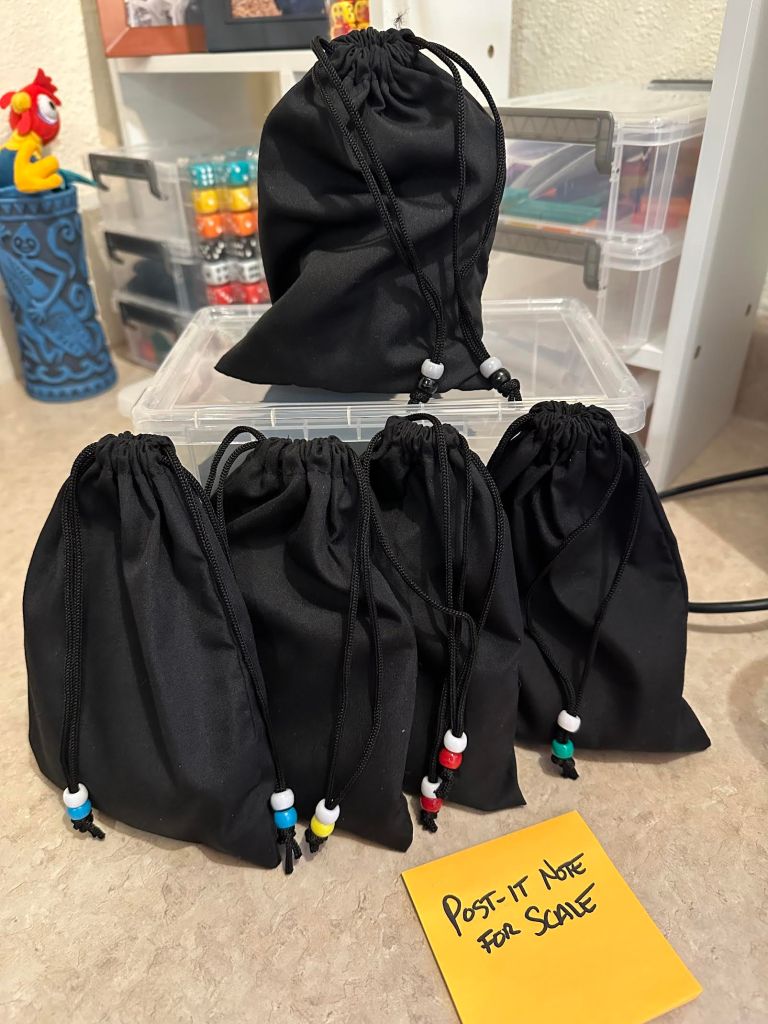
As for the player components, I knew I had to continue the pattern of minimizing and simplifying setup. I found ways to reduce characters down to a collection of cards and other small pieces, all of which could fit in a 4″ x 6″ cloth bag. To prep their characters for a play session of Disco Candybar, each player takes their bag, pulls out their cards and a few other items, arranges them in front of themself in a space not much bigger than a sheet of note paper, and they’re ready to go.
And for those looking for some actual details of gameplay, each bag is a game component unto itself. Nothing goes to waste. Yes, there’s a bag-building component to Disco Candybar, but that’s not actually saying much; you can put a lot of different things in a bag.
The enemies and monsters your characters fight against are almost equally as condensed. If you look at the image at the top of this post, you’ll see one bag with black and gray beads on the drawstrings. That’s currently the entire monster auto-pilot/AI system. Right now the prototype is built to demonstrate a single battle between the players and a band of goblins, but that array of monsters will absolutely grow into a full bestiary as the game fills out. As that growth happens, all the parts for all the enemies in the game will fit into a space something like a standard deckbox for a trading card game… and each battle will still only take a few seconds to set up.
I’m sure I’ll eventually show you all of what’s in the bags, but that’s a bit down the road. And man, is it equal parts impressive and unremarkable. Which is kind of cool in its own way.
Stay tuned. Next time I’ll talk a little about how the playtesting has been going so far.
PREVIOUS:
Starting On an Adventure (Game)

 DiscoCandybar.com
Leave a comment