
There is, in my experience, a double-edged sword element to designing any game based on a strong intellectual property (IP). On one hand, a rich IP will give you a very strong base to build meaningful mechanics on and around. On the other hand, miss the mark and your game will lack resonance with the fans of that IP, and may flounder regardless of the quality of the actual gameplay.
So how do we optimize the mechanical themes in a Trading Card Game to really make it feel like you’re a part of the IP? I’m actually going to take a short detour through board game design here for a minute. Don’t worry, it’s all pretty universally applicable.
In my career, I’ve made and worked on a lot of games based on movies, TV shows, video games, and books. I’ve created games from scratch for films like Die Hard and Stephen King’s IT. I’ve adapted classic board games like Monopoly, Clue, and Talisman to carry the stories of Breaking Bad, Labyrinth, and Star Wars. In all of those designs, the primary goal was to evoke an immersive experience that felt true to the IP through game mechanics.
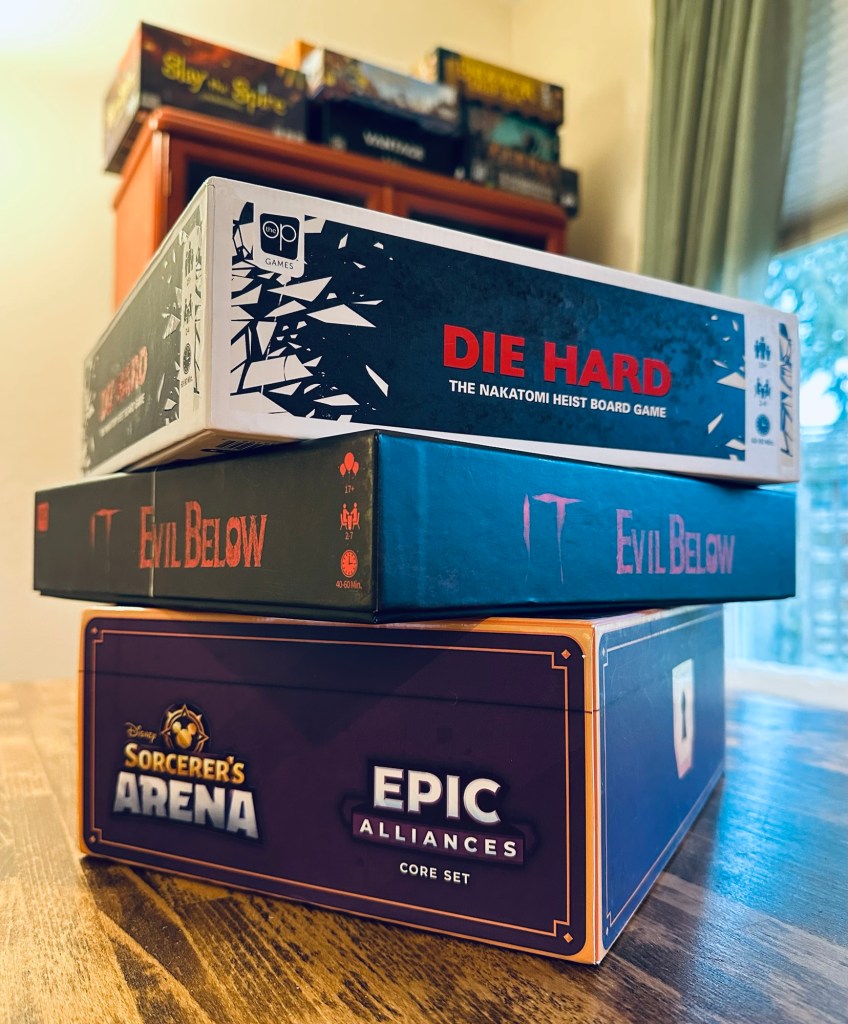
For Die Hard: the Nakatomi Heist (co-designed with The Op’s Pat Marino), we determined that the gameplay pattern would be built on a “one versus many” structure. The John McClane player is on their own, using a deck of cards that becomes more and more effective as the game goes on, mimicking the way the action keeps ratcheting up throughout the movie. Hans Gruber’s team of thieves is played by multiple players working against McClane, working silently (literally — no talking while selecting actions!) to coordinate their moves and hack the computerized lock system. Together, you get the action-movie tension of a lone cop sneaking through a building while being hunted by a group of heavily-armed terrorists.
Now, some have asked why we didn’t use a “hidden movement” mechanic, where McClane would be functionally invisible to the thieves for much of the game. Pat and I determined early on that if the thieves players never actually see McClane on the game board, there was a good chance that there wouldn’t be a ton of fighting/shooting in any given playthrough. We wanted to maximize those fights, so we sort of capped how stealthy McClane could actually be, and found other ways to evoke the sneakiness in the gameplay.
But that’s board game stuff, and I promised you a story about TCG design.
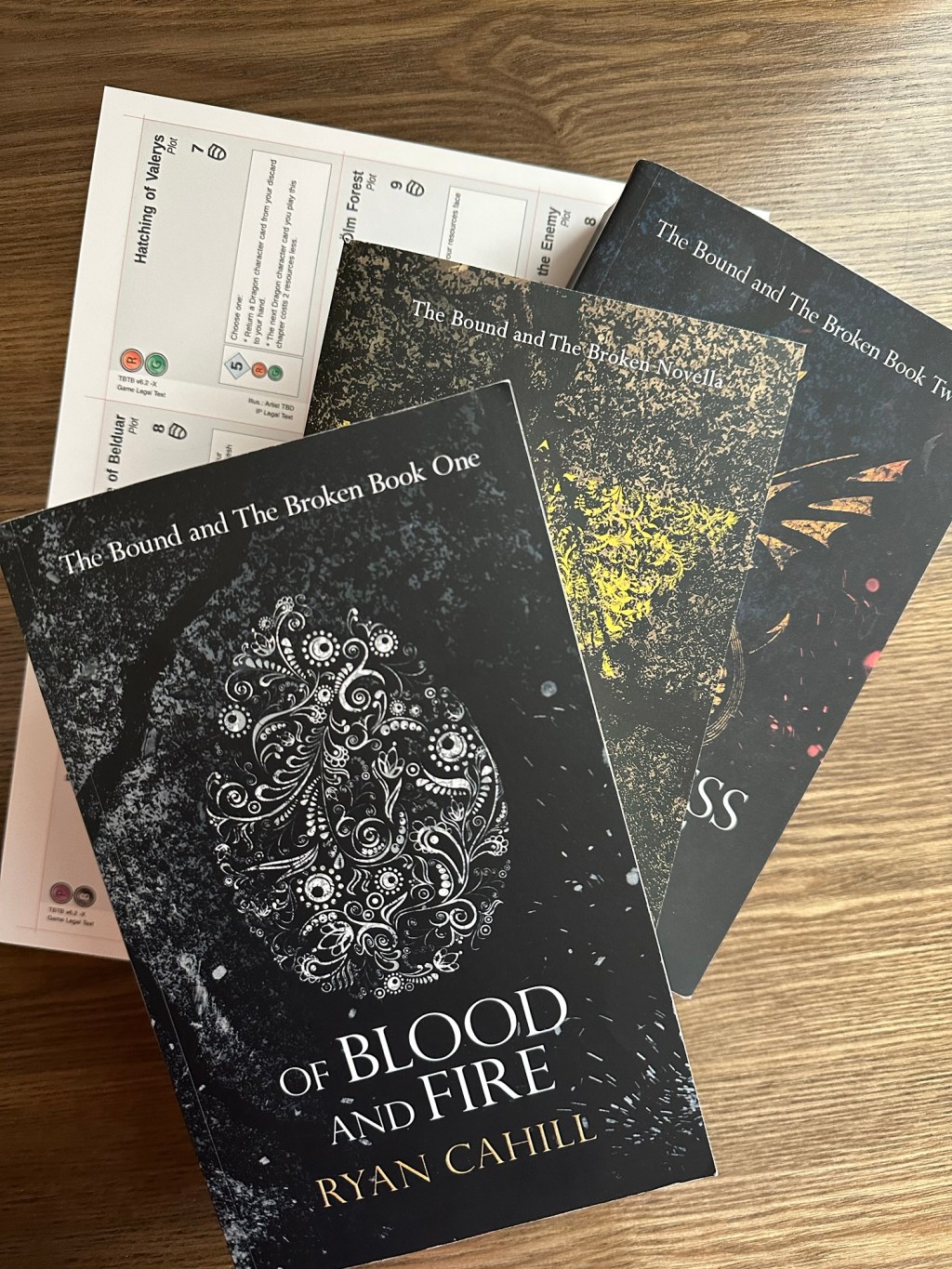
Over the last few months (and blog posts), I’ve been working on a TCG with another designer, Dave Freeman, for a fantasy author from Ireland named Ryan Cahill.
When you read Ryan’s books, it’s impossible to ignore that their scope is insanely huge. Lots of cool characters. Lots of intrigue and elaborate, interwoven plots. Lots of backstory, lots of battles, and lots of bloodshed. Oh, and dragons.
Plainly put, The Bound and the Broken (the series of novels) is a perfect base to build a fantasy-themed TCG around. So how do we go about making the TCG feel like it’s built to be specifically about these books? We identified a few different ways to do it, all of which worked at different layers of immersion.
LAYER 1: Surface Theming and Card Design
This was the low-hanging fruit of the project. Ryan’s written several thousand pages of story in his novels and novellas, and like I touched on earlier, they’re chock-full of characters, dragons, places, heroic and evil deeds, and more. The simplest thing we could do to evoke his world was to design cards that literally referenced those story elements in name and design. Make Calen Bryer’s card(s) do things that Calen is specifically known for in the books. Capture the gravity of the first appearance of the dragon Valerys in a card function. Give Eltoar Daethana a design that reflects his own brand of righteous cruelty.
Get these right, and the fans will find favorite cards, not just for their strategic/tactical function in the game, but also for the way they reflect the characters they’ve gotten to know/love/fear in the source material.
LAYER 2: Flavorful Game Sub-Systems
One interesting element of Ryan’s worldbuilding is that there are many different kinds of magic. A character who casts spells via attunement to the threads of The Spark may not also be skilled in the use of Blood Magic. A Knight of Achyron derives magic through a special sigil, bound to their soul. Druids have their own kinds of magic unrelated to the previous varieties. These distinct subclasses of magic needed ways to all function with or without casters of their specific type in play, but be better when a corresponding character was there to help.



The simplest solution was to just give a discount to the player when they played a magic spell card of a type that matched a character they had in play. It’s as if you, the player, can use any kind of magic, but you’re not as trained in specific kinds as specific characters are.
Every Magic Action card comes with a tag and icon, like those shown above. Got a character on the board with one of those symbols? Excellent! You pay one less resource to cast that spell. It’s super-basic, and will certainly get refinement and variations as we dig deeper into developing the game, but for a prototype it functions really well.
And if Ryan ever adds new kinds of magic to his world? No problem. New spells, new icon, same old process for fitting it into the game’s structure.
LAYER 2.5: Flavorful Language for Sub-Systems
This one doesn’t get recognition as an entire layer of its own because it’s very much a general aesthetic thing, rather than a The Bound and the Broken specific thing. I’ll keep it short and quick.
One of the primary devices of Dave’s combat-first model is a rounds/turns structure that sets the pace for when players draw, reset, and use their cards. The early rounds of the game are usually pretty quick, with players taking 1 to 3-ish turns before the next round begins. As you go deeper into the game, players have more choices available to them, and therefore will take more turns in a single round. All of these turns and rounds add up to a game.
To get a little clever with it all, I’ve started referring to the rounds as “chapters”. What happens in a chapter in a novel? All kinds of things, but generally speaking, it’s about progressing the story forward. Same deal with the chapters in this game; a bunch of stuff can happen, but summarized, somebody (or everybody) is making forward progress.
I’ve also begun referring to the cards in your resource area collectively as your “book”. It’s got a bunch of little paper things in it, they turn; it’s just like a real book. The cards in your book might even be “pages”. I haven’t really decided how I feel about that yet.
Do these things need flavorful names? Not strictly speaking, no. Do these names help set up a more immersive, tailored experience? Absolutely.
There you go, half a layer. Back to the really important stuff.
LAYER 3: Game Structure as a Reflection of Book Themes
This one can be a doozy. It’s like the Die Hard game design I talked about at the top of this post; an IP-driven game should evoke the same feelings or emotions as the source material it’s built on. How do we make the entire game, regardless of individual card designs or sub-systems, feel like you’re experiencing an epic and rich fantasy story?
Dave and I began exploring this question by making two completely different, divergent game prototypes. We each focused on different elements of the theme, with a plan to get playtester feedback on both. Once we knew the things that players liked, loved, and were lukewarm on with each, we could make a plan to refine each model with those notes, and possibly hybridize them to combine the strengths of two models into one.
The first model Dave built was focused on pushing combat to the forefront. To boil the game down to it’s most direct description, each player was able to put characters on the board one by one, and send them into battle in an effort to destroy their opponent’s location cards. There was a very tactical feeling to it all, and the focus was clearly on making every attack and gambit count. With an IP so grounded in tales of epic battles, the game and prototype were pretty much in line with the books.
My build looked at things with a wider, but less specifically focused lens. In the first few iterations of my prototype, I wanted to put the focus on immersing yourself in a story, or at least in selected arcs from the books.
You did this by completing “quests”, which were basically cards representing small story arcs. Every character you played could be used to either attack and foil your opponent’s quests, or be assigned to work on completing a Quest card. The details of how exactly that worked varied from version to version, but for the first three or four iterations, that was the play pattern: put characters into play, attack or work on quests, win.
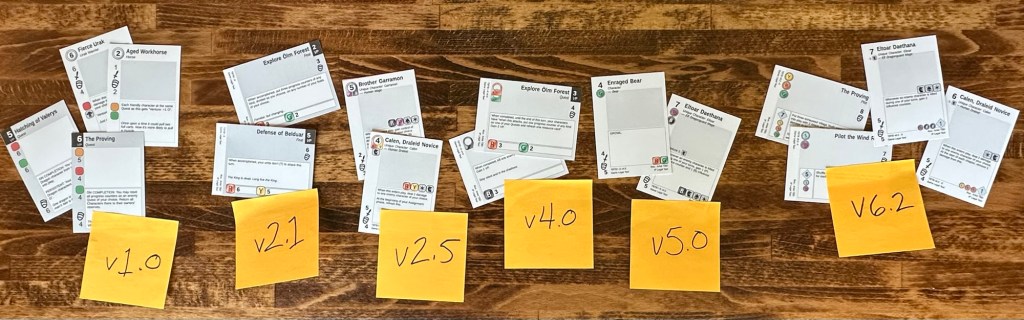
The earliest designs of this model put the focus on getting the win by “telling your story”, but in testing we found that it made the clearest path to victory a very uninteractive one: build an impenetrable wall of defenses and put all your other resources into getting the Quests done. There wasn’t a ton of reason to get invested in attacking your opponent if your quest engine was faster than theirs, so the best decks just pulled their heads into their turtle shells and… did nothing aggressive at all. Competitively slow-walk your way to victory.
For a game that was supposed to reflect a story with epic battles, it was sorely lacking the epic battles.
So I pivoted the focus. I restructured the game so that your win condition centered on attacking and defeating your opponent’s Quests. And what do you suppose happened?
The only thing worth doing was attacking. Assigning your characters to work on a quest was, more often than not, one character fewer taking out your opponent’s quest. Working on your own quest just meant that you weren’t progressing towards your true primary goal.
Next I tried a model where you could make forward progress through both strategies. Defeat an enemy Quest (at this point renamed to “Plots”; the term is more generic, but more fitting for certain kinds of story arcs) and get some Victory Points. Complete your own and get a few more VPs. It allowed for a player to go all in on aggressive attacks, supplementing those Victory Points by activating one or two of their own Plots… or conversely, you could go back to the “turtle up and slow-roll on your Plots” method, but it wasn’t generally as efficient as a good old fashioned brawl. By changing the “currency to win” to something fairly flexible, it allowed players to choose and change plans as they went. Sort of like plot twists in a book. Mostly linear, but with a few branches to explore here and there.
I’ve since built a model where I streamlined the VPs out of the equation again — there were a bunch of different things to track, and the game needed to lose some of that to be more accessible — but I’m honestly starting to rethink that. The in-game “path to victory” flexibility was just really appealing and relatively unique. I’m sure there’s a way to make all of the gears mesh seamlessly with less fiddly stuff than the previous version, if we can just find it.
I’d love to be able to tell you what we ultimately arrived at as our final game model, but the truth is we’re still making a few adjustments and dialing things in. I can say that there’s going to be stuff that comes from Dave’s combat-heavy model, and stuff that pulls from my Quests/Plots builds, but we’re still ironing out the exact balance of those things. And I’d be a terrible design partner if I spilled to all of you where this was heading before Dave and I got to update Ryan (who’s currently on tour in Australia being all famous and shit*).
(*We’re actually all genuinely very happy for him and his success; he’s an awesome dude, and his books are well worth picking up — and getting signed, if you have an opportunity.)
 DiscoCandybar.com
Leave a comment