
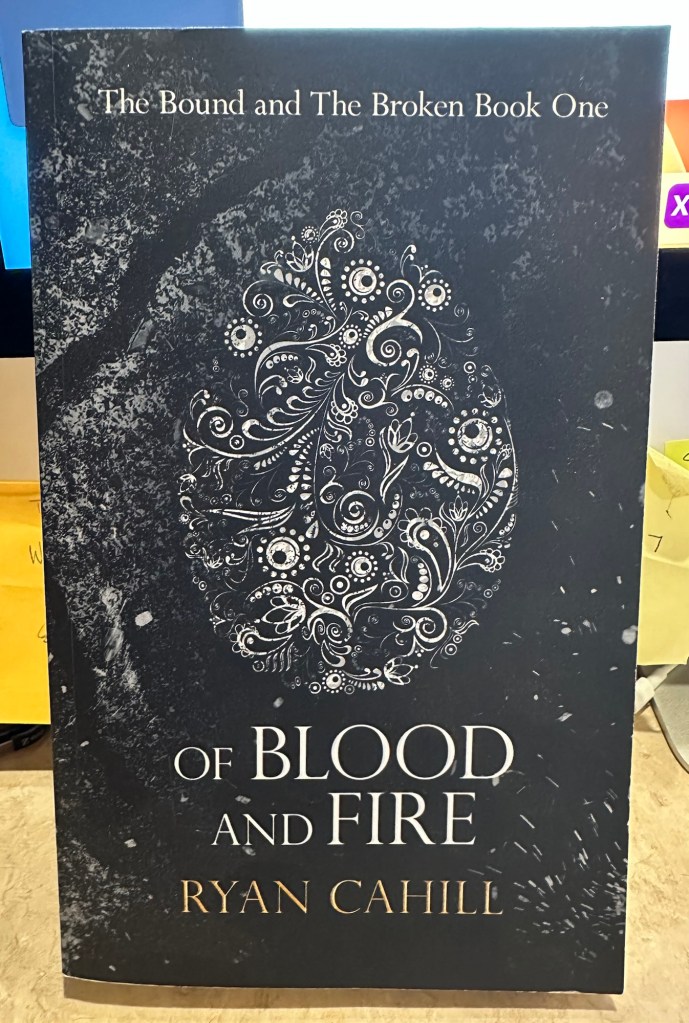
For the last month and a half, I’ve been putting quite a bit of my time into designing, playtesting, and developing a trading card game based on Ryan Cahill’s The Bound and the Broken fantasy novels. I’ve mentioned it in a few previous posts, notably Your TCG/Board Game Needs Barrels and Preparing For the Playtesters’ Turns.
The central team behind the project is me, Ryan, and another local designer named Dave. In addition to the three of us, we’ve got a support team of about 8-15 playtesters (depending on their schedules) all around North America and Europe. We “meet” and discuss the project through Discord, and about 95% of our playtests are done online with a Tabletop Simulator build (some of us have printed paper versions, but as mentioned in Playtesting Your TCG/Game — Paper or Pixels?, there are efficiency issues with outputting constant updates for paper prototypes).
Through this past November and December, Dave and I were designing two separate game models, with the intent of putting both in front of playtesters. Our goal was not to develop and tune the two games, but to let the testers compare and contrast them, identifying the strengths and weaknesses of both. With two different games on the table, it can be easier for observers to pick out what’s working best between the two and what’s not.
From the 10,000-foot view, the two games are both built around some traditional character combat structures; your characters have a cost to play them, an attack and defense score, and some abilities that help them feel like what we’ve named them. Both games have action cards that can be played to impact the board state without putting new “pieces” onto the table. In both games, you’re facing a single opponent, trying to deal damage to their Base/Quest cards, and when you do that enough, you win the game. After that, there are plenty of things that make the games feel distinct from one another.
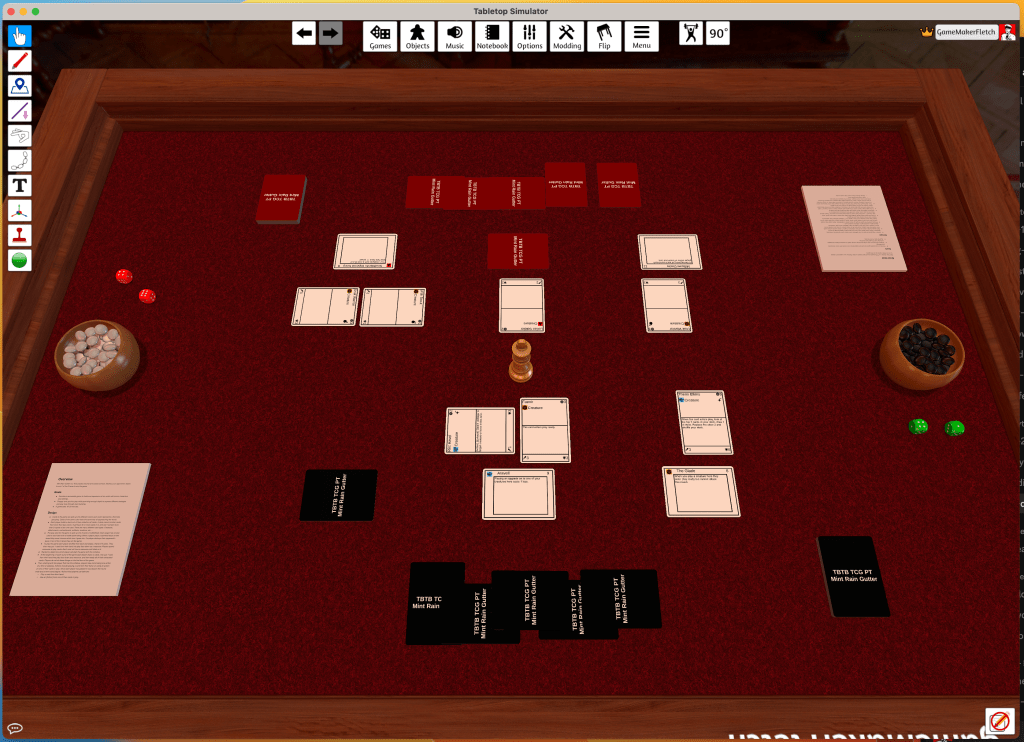
“Lanes” is Dave’s game. It’s built with a play area consisting of three lanes, with each player placing a base at their end of each of those lanes. When you play a character, you decide which lane to place them into, and they’ll do their attacking and defending specifically in that lane until you actively move them to a different lane. If you deal enough damage to knock out two enemy bases, you win. It’s also got a round/turn structure that limits players to only one decision per turn — you can play a card OR attack with a character OR choose to take a token giving you the first turn in the next round, but you can’t do more than one of those things at once. After your opponent has taken a turn , you’ll get another chance to do stuff, and when both players have run out of things to do in the round, everything resets and a new round begins. Accessibility was a very central piece to its construction.
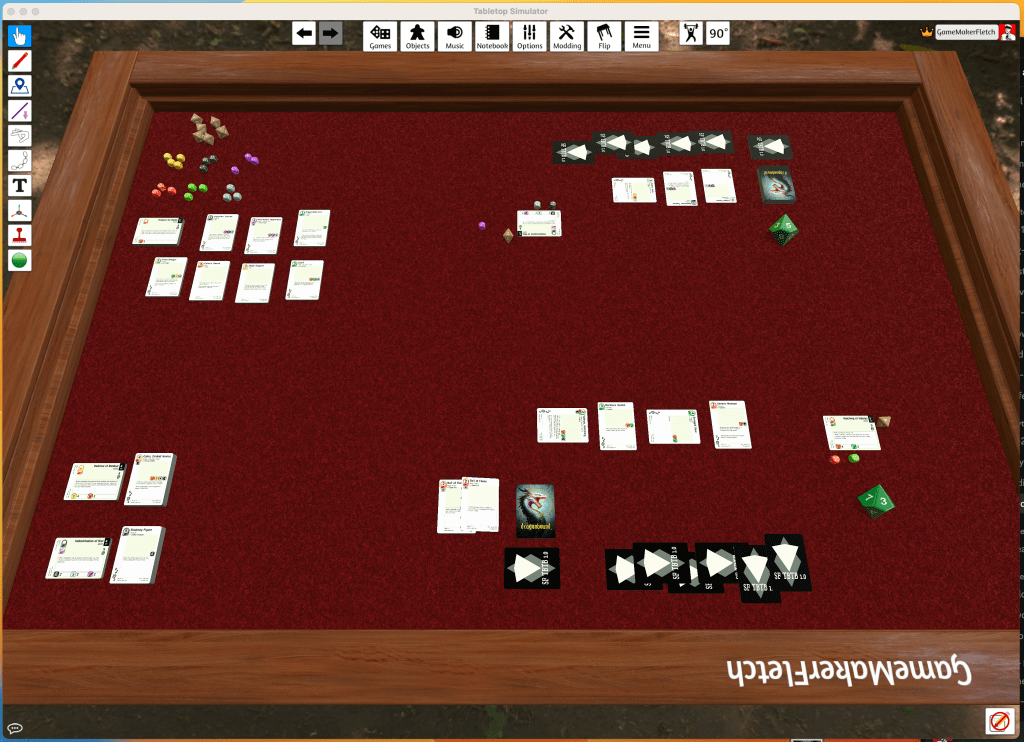
“Quests” focused more on an open turn system and board — do as much or as little as you’d like on your turn, per the resources you have available, then pass the turn and let your opponent do the same. It had a two-deck structure, so that the cards that served as your resources existed separate from the main deck of cards you played from. Resource cards pulled double-duty as Quests, as at least one card from that deck would also serve as a target for your opponent to attack. Quest cards could also be completed using a secondary resource for tactical advantages and victory points, and gave guidance to what kinds of cards should go in your main deck. It was generally more complex than Lanes, and a little tougher to learn, but there were a lot of dials and levers players could experiment with.
We brought the “Lanes” and “Quests” versions of The Bound and the Broken TCG to the playtesters in January. Our playtesting group was primarily recruited from among Ryan’s fans, but we filtered for people who were abundantly familiar with trading card games. Ultimately, we signed up about 50 people to help us improve the games. The math of online community engagement meant that around 15-20 of those players remained closely involved in the project as it moved forward, and that was enough for us to work with.
Ryan set up a Discord server for the testing community, and I leaned heavily on my own experience running online playtests to structure the channels. As players joined the Discord server, we assigned them tags that will give them access to restricted parts of the server — forward planning for the eventual day the server is opened up for all fans, including those who haven’t been selected to help test the game.
There’s a channel on the server specifically reserved for links to all the materials the testers need to play and report their opinions, so they can jump in whenever they and an opponent have time to play. Included in that channel is the “High/Low/Buffalo” review form for the two game models. After their first play of the different models, a player can click in, leave their initial thoughts, and be done. If they’re engaged enough to play more games, there’s an open chat channel for that (though I encourage playtesters to avoid that if they have not played the games at least once).
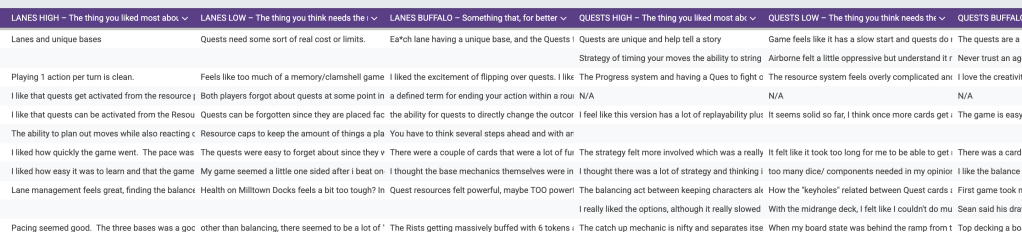
A few of the responses in each column…
LANES – HIGH (something that stood out as a real strength)
- “Lane management feels great, finding the balance of how much to commit to a lane was super fun. The card effects are interesting and impactful.”
- “The pace of the game and the resource gain felt better than the other game.”
- “Playing 1 action per turn is clean.”
LANES – LOW (something that needs more work)
- “My game seemed a little one sided after I beat one base. How can the other player come back? I would also like some more in depth strategy moments.”
- “There seemed to be a lot of “stand offs” where the correct action is to not attack. He who flinches first loses.
LANES – BUFFALO (something memorable and/or surprising)
- “You have to think several steps ahead and with an eye on multiple lanes.”
- “I thought the base mechanics themselves were interesting and offer a lot of promise in the future.”
QUESTS – HIGH
- “Quests are unique and help tell a story”
- “Decision point between keeping your characters ready/alert to progress your quests or using them to attack your opponent’s quests.”
- “I feel like this version has a lot of replayability plus is better suited for multiplayer formats and themed formats.”
QUESTS – LOW
- “Determining cost took us second to get the hang of.”
- “Game feels like it has a slow start and quests do not feel like they resolve as often.”
QUESTS – BUFFALO
- “This system feels like it puts the power in the player’s hands to make decisions about how they tune or modify their deck, their hand, and their game choices.”
- “The balance between choosing resource or quest is interesting and new take to the genre for me.”
From this feedback, we were able to make some big determinations about the next iteration of the games. Dave and I are each building our own “next versions” right now, which we’ll put up for contrast-and-compare notes from the testers, just like before. With the testing notes from round one, we expect both new models to start converging on the ultimate “right model”. While Dave’s working on his build (I know some of what he’s got planned, but don’t want to go into details until he’s presented it), I can talk a bit about mine, and what I’ve learned from early testing.
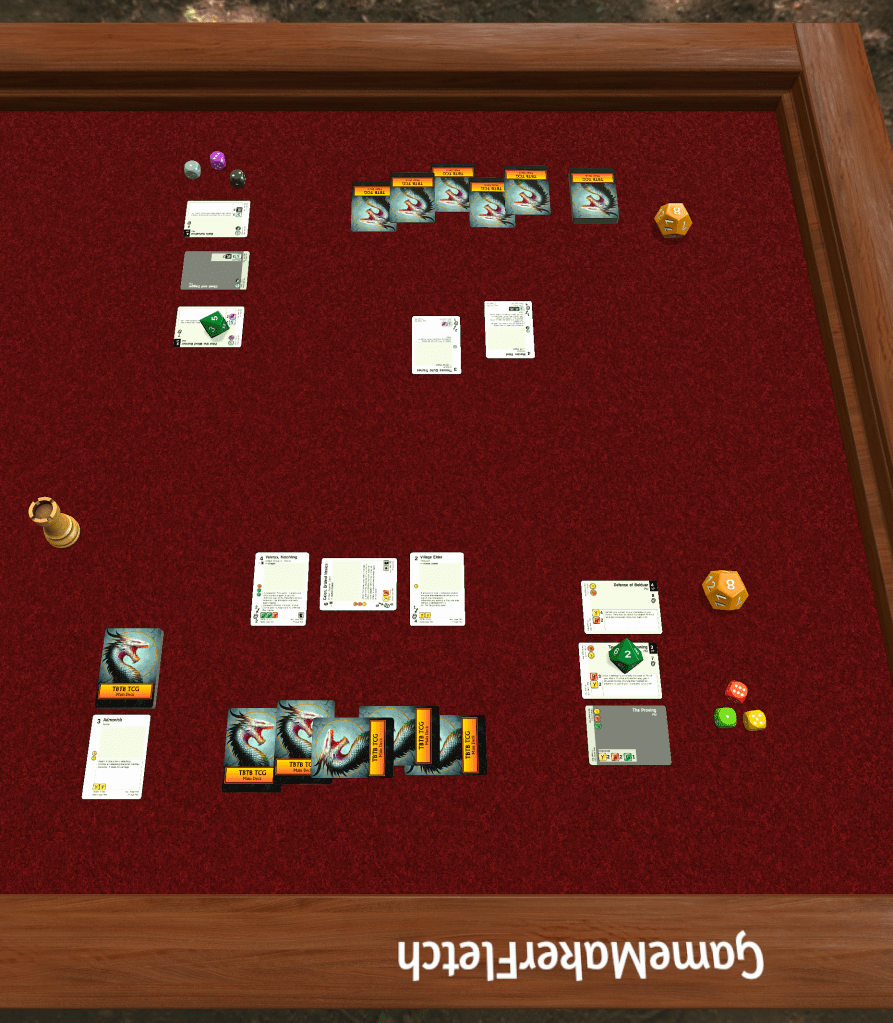
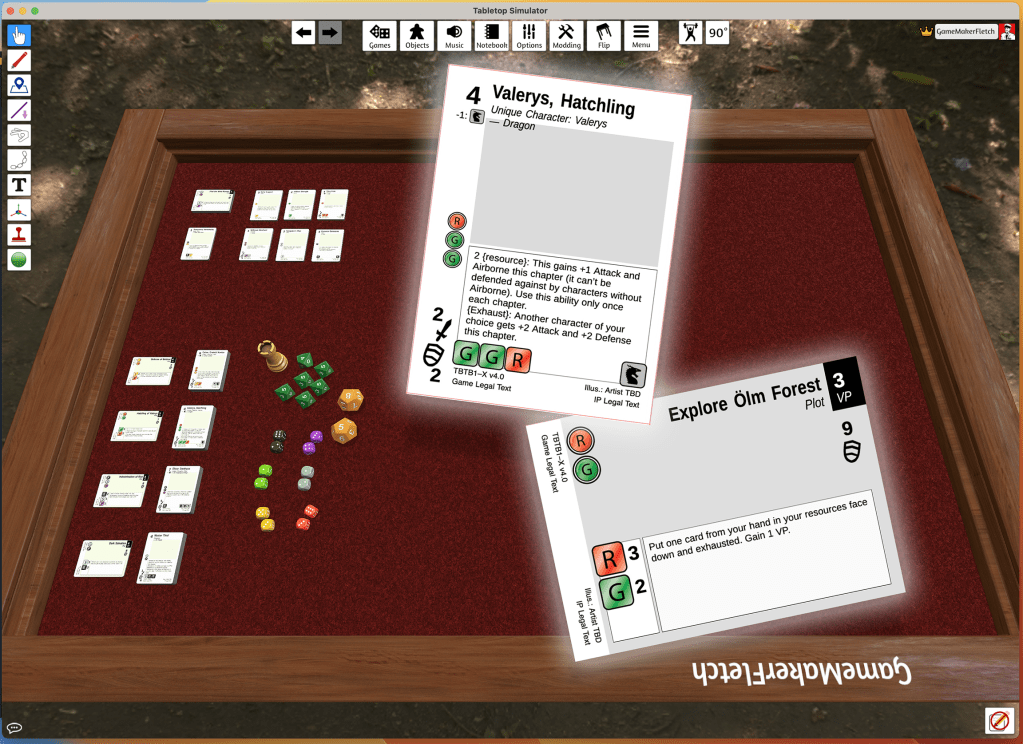
I’m calling this version “PLOTS”. It’s very much a hybrid of Quests and Lanes, but streamlined in some places, and expanded in others. It uses the rounds-and-turns structure of Lanes, and has a “defeat three opposing bases” win condition. It blends that with the open-board play area and secondary resource system of Quests. I streamlined the components into a single deck, largely leaning on the resourcing system from Dave’s build. I kept the tactical relevance of the Quest cards, now called Plots (hence the model name), from my earlier game, but I blended them with the Lanes bases in a way that simplifies the tracking of the secondary resources that fuel them.
Now, there are two ways to look at this kind of product melding. Just taking the best parts of two things and smashing them together is not a guaranteed recipe for improvement. I like fried fish sandwiches with cheese and tartar sauce. I also like chocolate fudge ice cream sundaes. In no way would I ever recommend ANYONE take their favorite parts of those two foods and blend them. There isn’t a single combination in those divergent dishes that’s remotely appealing. Genetically splicing two board games can be just that disastrous too.
On the other hand, when you breed two different kinds of dogs together, the offspring are most often heartier and healthier than either of the two parent breeds. Mutts get more of the positive genetic traits of each of the parents, and fewer of the negative ones. Don’t ask me why, I skipped most of the bioscience classes on my way through art school.
Based on early feedback, Plots is more of the mutt result than a fried fish fudge sundae with pickles and mayo. This makes me very happy.
It wasn’t great right out of the gate; I’ve actually reworked a few of the systems since the initial blended build.
Plots has a two-focus, two-resource system at its core. That means that you’ve got two different but interconnected ways to progress the game as you play. One is the direct conflict between the cards you play and the cards your opponent plays; attack their Plots to earn Victory Points. The second is the less directly interactive progress you make on your three Plots, which start the game in play. The former is fueled by an incrementally growing pool of (capital “R”) Resources — cards that can be turned sideways to pay the cost of cards in your hand, and that refresh at the start of each round. The latter is powered by Influence counters that you get when you place cards from your hand into your resource pool, collected once per Resource card played. As a turn action, you can spend your accumulated Influence counters to use any of your active Plots, getting a tactical reward and one or two Victory Points.
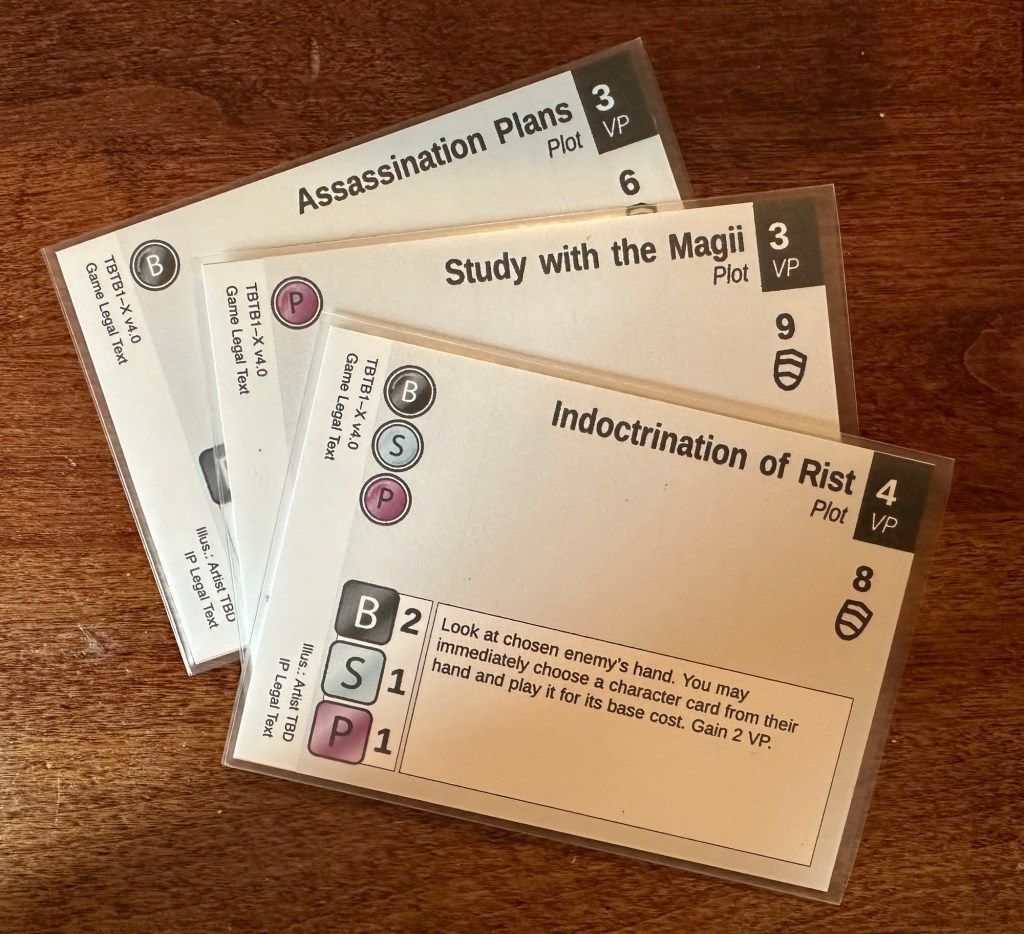
Originally, the Influence counters were generated by your characters, dependent on whether you’d committed them to attacking, or held them back to defend. It was something very close to a holdover from the Quests model. What we found in testing Plots though was that when a player had no characters — either they couldn’t play them from their hand fast enough or they all got killed — it meant they were probably losing the game on multiple fronts. No characters in play meant nothing to attack your opponent’s Plots with, and also that you weren’t generating Influence to use your own Plots. Lose/lose.
The solution came out of a fairly random brainstorm with some playtesters. I decided to decouple the Influence production from characters altogether, and to see what happened if we gave you Influence counters when a card got put into your Resource area. It required a little bit of adjustment on several of the prototype cards, but ultimately it seems to have worked — and it adds a whole new dimension of pre- and mid-game strategy in identifying which cards to put in the deck to start with, and which card to move from your hand to your Resources at the start of each round.
There are plenty of other things about the current Plots version that improve upon the Quests and Lanes models, but there’s also a lot more testing to do, so I don’t want to get too far ahead of myself. I’m sure I’ll be telling more stories about Plots (and whatever comes next) soon. For now, I’m really happy with the progress we’ve made through iterative testing, analysis, and reconfiguration.
He’s a good doggo.
 DiscoCandybar.com
Leave a comment