
I’ve mentioned in some recent posts that I’ve been working on a project with another game designer named Dave. Our project is getting very close to a major decision point, so I thought I’d tell some of that story today.
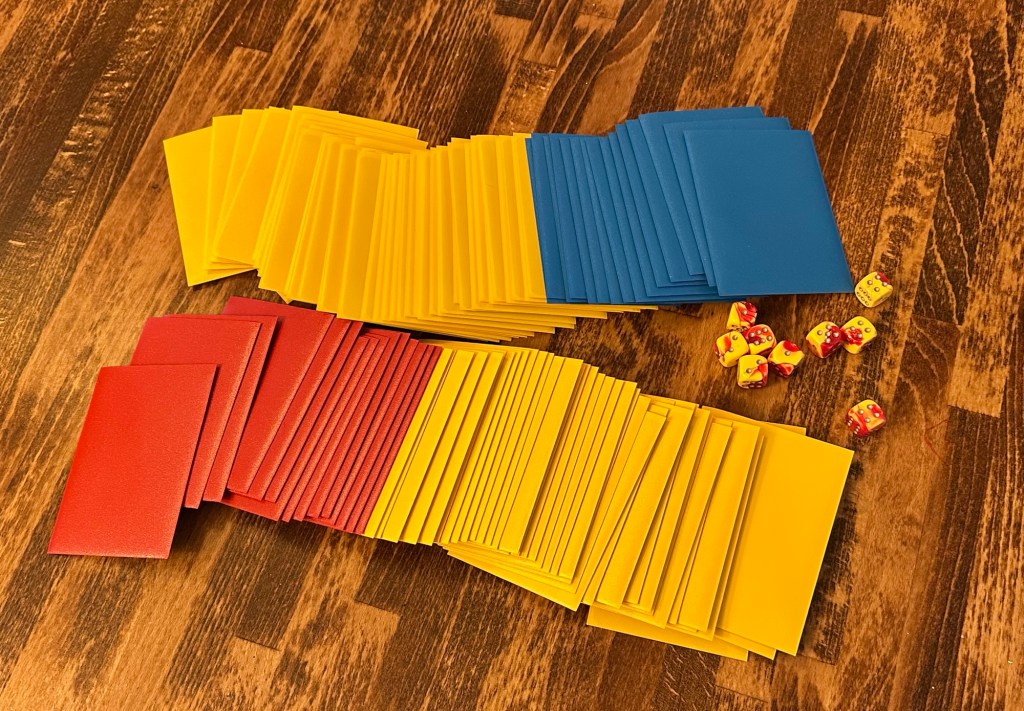
It starts with a third project participant I haven’t talked much about yet; really, a client, but one who’s been very engaged with the project’s inception and creative evolution so far. His name is Ryan, and he’s the author of a series of fantasy novels.
Ryan has a Patreon community that helps him fund projects related to his books — short stories, art prints, and even physical replicas of artifacts from his novels. Recently, while producing a set of collectible art cards based on his characters, he had an idea: given all the art that was being created and formatted for something the size of a playing card, why not make a trading card game out of them?
Ryan reached out through his various contacts, and eventually struck up a conversation with Ross Thompson. Ross is one of those super-networked guys who has great social and business connections with a ridiculously huge portion of the tabletop gaming industry. Fantastic guy, knows all the best places for burritos up and down the west coast, and someone I’m proud to say is a genuine friend. I was blessed enough to work pretty closely with him for several years, and to learn a lot from him in that time.
But while this story goes through Ross, it’s not actually about him. To the point, Ryan told Ross about his idea and goals, and Ross gave him a short list of people to reach out to who might be able to help him take the idea from his imagination to actual foil-wrapped packs of playable game cards. Dave and I were both on that list.
There’s a whole bunch of smaller stuff that bridges the gap between introductions and the work done on the project, but I’ll skip that. Imagine it as a montage sequence of emails and get-to-know-the-team video calls. Groundwork stuff. Coffee and notebook sketches for me and Dave at a local Starbucks. Those kinds of things. Fast forward to:
Dave and I each started some rough designs for directions and themes for the game. We presented them to Ryan through emails, video calls, and an eventual Discord group. Ryan was fascinated by both of the ideas Dave and I each led with. I think we as the designers were a little surprised when Ryan didn’t give an indication for preference on a path (the typical route taken by a client is often to focus on a single idea), but instead said he wanted to see more of both games fleshed out. Ryan’s goal was for the game to appeal to an audience that was savvy to strategy games and TCGs, and he wanted to have multiple options to present to eventual impartial testers. Let the audience determine which game had more gas in the tank.
It’s worth saying again, as I’ve said in other posts, that Dave’s model is really good. I’d absolutely dig into it and play it if I stumbled onto it in a game store or was shown it by friends. I like my model a lot too; I think it measures up well to other games I’ve designed, and like nearly all of those games, they’re my babies and I’ll back them as far as I can. Either way, with Dave and I being design partners on the project, we’ve both gone into this prepared to support the design of whichever game the client eventually selects to move forward with.
Checking our egos at the door (as one does for a client), we both felt Ryan’s logic in getting third-party feedback was valid. It wasn’t so much that Ryan was punting on making a call himself, but more his awareness that a larger audience would be able to cover more ground than him alone in analyzing and comparing the games. In a field where both models were viable, broader audience reaction was and is a sound way to find the road to the most appealing game. And if both games still have deep appeal to the bigger audience, we can use their feedback to blend the most-liked parts of each into a single game.
So Dave and I continued building out our games to a point where we could confidently demo them side-by-side, with enough meat on the bones for both to feel “finished enough” to be fairly compared and contrasted. We’ve both done thorough testing to make sure our game models are sound, and played them numerous times with our team of three. We’ve designed enough cards — 20 to 25-ish percent of a full set — in each of the two games to reliably show the variety of play styles available in both. And we’re getting really close to needing to find our pool of testers to give their First Impression feedback on the games. (Get a refresher on First Impression playtests here.)
The first step to running these tests is finding and categorizing playtesters. In my experience, you’ll find the most potential testers for a project like this through existing online groups with shared interests. These will largely include Discord servers and groups based on social media platforms. Ryan already has a fairly organized online fan base for his books, so that’s one place to start for us. Dave and I have both been designing games for years, so we each have our own network of game fanatics and social groups to reach out to. We’re hopeful that gathering an audience of curious and enthusiastic one-shot (or in this case two-shot) testers won’t be particularly difficult.
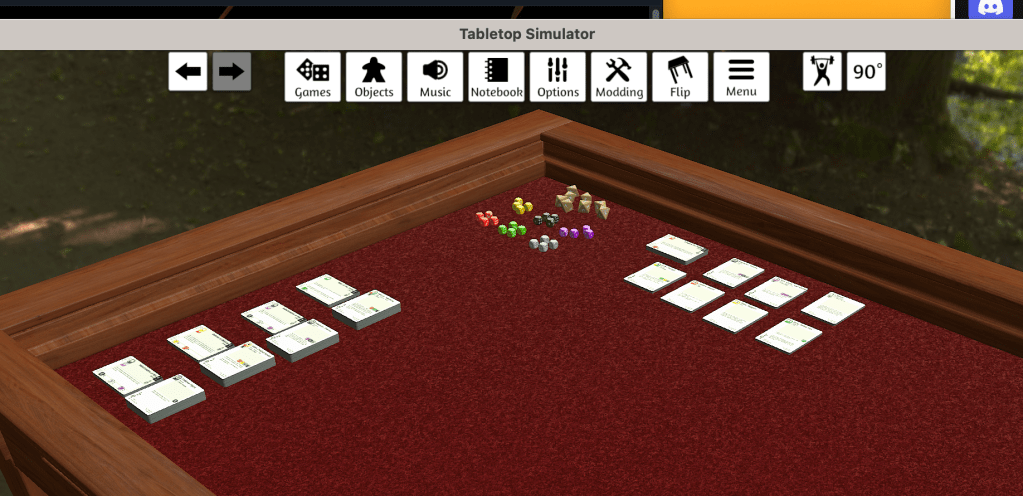
Our game prototypes exist in both paper and Tabletop Simulator, but to reach the widest possible audience geographically, only that second medium really matters. It may be something of a gate that could prevent prospective testers from trying the games, but since Ryan has established that he’s focusing on a more game-savvy audience, we’re hopeful here too. Familiarity with Tabletop Simulator translates fairly well to familiarity with the kinds of games Dave and I have made. This means we’ll be getting closer to the kinds of feedback that are most meaningful to us in our assignment.
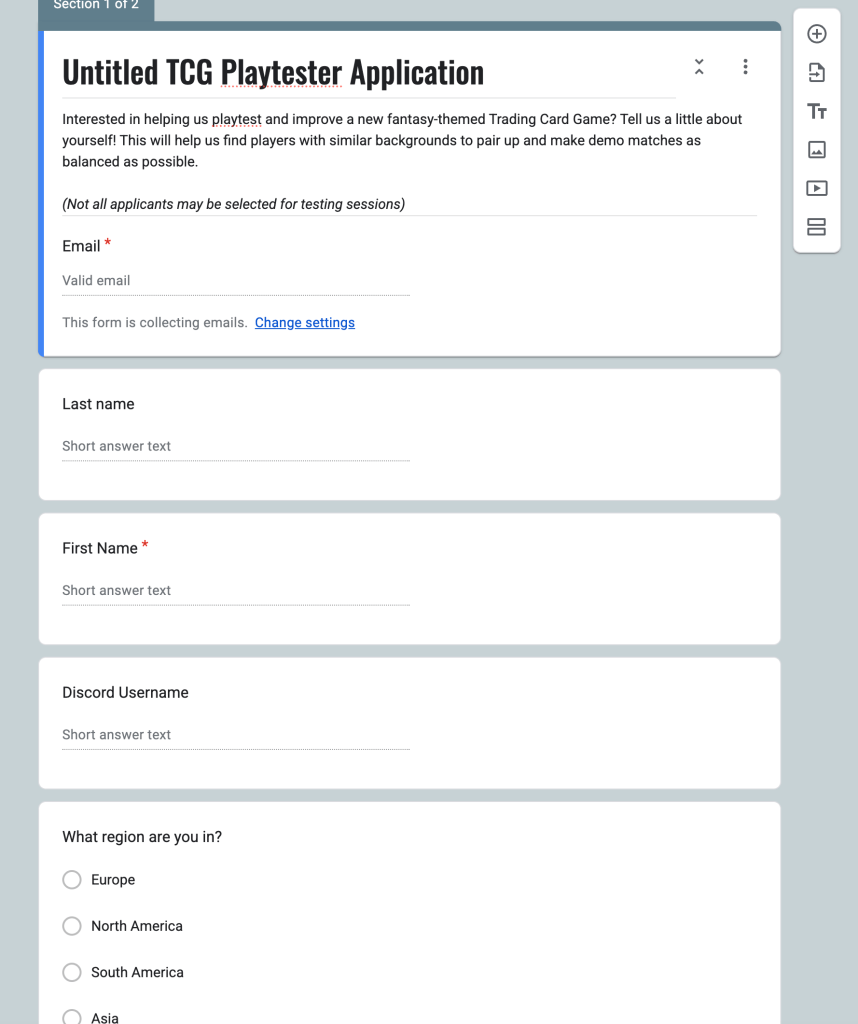
We know how to find a pool of playtesters. We know how to give them the games to play. Next we need to narrow down which volunteers are right for our tests. That’s where we turn to a pretty basic and accessible tool: Google. Google makes a survey form builder that automatically feeds results into a spreadsheet. You’ve probably seen them before; built properly, they’re very easy and intuitive for an applicant to fill out. Happily, they’re really easy to build properly too.
At the center of our dart board, we’re looking for people who enjoy playing trading card games. Moving outward from that bullseye, someone who knows a variety of different TCGs is a good fit for our focus group. Moving further out, we’re interested in finding out if an applicant is a fan of or familiar with Ryan’s novels. That last element isn’t critical to determining which game model players enjoy more, but it can help settle ties where it comes down to which game showcases the vibe of the stories better.
We’re also asking applicants to tell us where (generally) they’re based. This helps us determine ideal times to run tests, setting up windows where players in the same or proximally close time zones can join games. In the long term, it may also help us identify regions where we think the game might be popular.
Once we’ve gathered and compiled all of the responses in the spreadsheet, we can start inviting our chosen applicants into a Discord server, where we’ll be able to provide them access to the games and their rules, and help them find opponents to try out the games with. Discord also gives us a good way to keep a dialogue going with the playtesters, both passively in text threads and actively in live calls.
After that, it’s live television, so to speak. All bets are off, and it’s all about responding in the moment and waiting for the players to tell us what they think. Given a few weeks of feedback, we should have a pretty good idea of where the game is heading.
Stay tuned. I’m sure I’ll be posting the official kickoff of our tests and a link to the application survey here soon. We’d love to get all your thoughts, likes, and dislikes for our game(s)!
PREVIOUS:
REINDEER POKER: A Free Game For You!

 DiscoCandybar.com
Leave a comment