

It’s the holidays, and I’d like to give you all something I made myself!
(Okay, to be fair, it’s a game variant I made myself. I can’t claim credit for inventing Poker, just this way of playing it.)
(And to be even more fair, this is sort of a secondhand gift.)
So before we get to the game itself, Let me tell you the story of the night (or afternoon) before a Christmas-themed game was designed.
Yesterday, just about 24 hours ago, my brother in law Scott messaged me with a request for a somewhat-specific-but-also-vague game recommendation.
“Hey, I’m going to a holiday party, and I have a rather large white elephant gift that I want to award to someone, and I’d like a game that can be played to determine who gets it. Know of anything ten players could play in a head-to-head bracket structure until we’ve got winner that gets the prize? The party’s on Saturday.”
My first thought was to get a copy of a game that already sort of did that. Challengers! was the first to come to mind, but then that would require Scott to track down and purchase a copy, then teach it to all the guests. It’s also, while quick by many hobby game standards, not the fastest game to blitz through at an office part with other things going on.
So I pivoted, and thought about whether I could make something myself. I do do this professionally, after all.
“Give me a day or two”, I replied. “I’ll whip something up and send you a game you can print and play.”
I mulled on it for an hour or so, then determined I needed to ask a few more questions to pinpoint exactly what needed to be designed.
- Do you want something super-light, like a fancier Rock/Paper/Scissors, or something with strategy and player agency? Response: Middle of the road, maybe?
- Do you want players to all play their matches at the same time, or do you want to structure it so everyone watches the one match that’s happening in the moment? Response: The second one.
From these two answers, I knew a couple of things. The game had to be very fast to learn, but deep enough that players didn’t feel it was all dumb luck. Given that the matches would al run concurrent rather than simultaneously, every match had to come in at about three minutes each.
I’d been considering crafting something completely original, but given how soon Scott needed the game — and not knowing if he’d have the time or materials to produce even a simple print-and-play copy — I soon settled on making an original, seasonally thematic variant on a traditional card game everyone would already know. Scott wouldn’t need anything more than a standard deck of cards, a table to deal them on, and the rules, which ideally were short and dead-simple to memorize and teach.
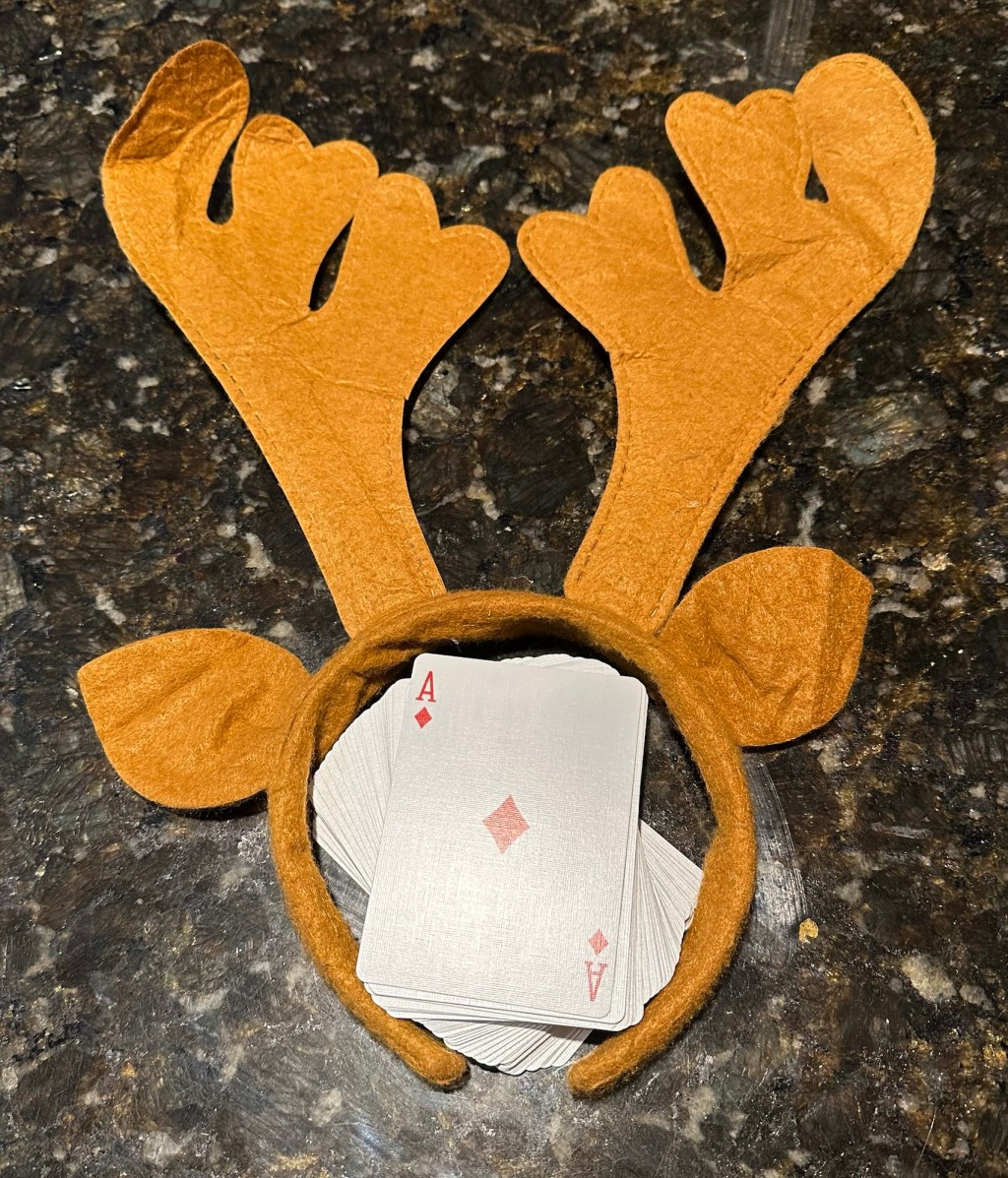
By yesterday evening, right before going to bed, I’d figured it out. Poker, but played by Santa’s reindeer. Rudolph leads (because that’s what he does in the song), and eight other reindeer, arranged in duos, pull Santa’s sleigh behind the red-nosed guide.
Here’s how it works, followed by a downloadable PDF for you to print, play, share, and so on. Enjoy!
REINDEER POKER
A light-strategy party game by Sean “Fletch” Fletcher to be played in 1-v-1 brackets
December 17, 2025
’Tis the season for reindeer games, and this time Rudolph absolutely gets to play too. Santa’s reindeer will be pulling the sleigh across the flop, turn, and river, but it’s up to the players to pair their reindeer up and decide the order to arrange them in. This is a quick-play variant on Texas Hold ‘Em, with no betting, just a single best-of-5 head to head matchup in each round.
Requires:
1 Standard deck of playing cards
1 Table
2-3 minutes per round
Clear enough space in the center of the table for five small stacks of cards, plus space on either side of each stack for players to add two more cards. Shuffle the deck and deal each of the two players nine cards. Next, put five stacks of five cards each face down in a line along the center of the table.
Players will each choose a single RED (heart or diamond) card from their hand as Rudolph. If they have no red cards, they may reveal their hand and receive a new hand of nine cards.
Players simultaneously reveal their Rudolph cards. Whoever has the higher value Rudolph card goes first. In a tie, determine the starting player randomly. Each player, in turn, places their Rudolph card next to any of the five stacks of five on the table face up. The Rudolph card counts as an automatic pair of that card, for value and suit.
Continuing in a SNAKED turn order (player 1, player 2, p2, p1, p1, p2, p2, p1, p1, p2), the players make four two-card sets at a time from those in their hand and take turns placing those sets face up next to a stack of five. Players may not place more than one set of their cards next to a single stack. Players do NOT need to place their sets next to the same stack as the previous player, but each stack of five cards will eventually have two sets of cards (one from each player) lined up with it.
Once all cards have been placed, reveal the stacks of five one at a time. Each player now makes a five card hand at each stack, adding any five of the five shared cards to their set. Whomever has the better hand wins that stack. Repeat this until one of the players has won three hands. That player is the winner of the round.
Return all cards to the deck, reshuffle, and bring in the next two players. Rinse and repeat as necessary.
In the unlikely event of a tie, the player who created the highest hand overall wins.
EXAMPLE: We’ve dealt the five stacks of five to the table.

Scott reveals a 9 of hearts as his Rudolph card. Sean reveals a Jack of Diamonds. Sean has the higher card, so he goes first in this game. He places his Jack of Diamonds (now a pair of Jacks) next to the first stack of five face up, leaving the five face down.

Scott then sees that on face value, Sean’s pair of Jacks would beat his 9s, so he chooses to put his 9 of hearts face up next to the second stack of five.
Now it’s Scott’s turn to lead. He has the King and Ace of clubs, so he puts those at a third stack of five that has no other cards with it yet.
Sean follows with a pair of 10s, diamonds and clubs, putting those next to the stack with Scott’s 9s. Without seeing the five cards between them, Sean figures his 10s have a good chance of beating
the 9s.

The placement of cards continues until both players have played out all of their sets. Then the reveals begin.
As the stacks of five are revealed, Scott gets three winning hands first. He wins the round and moves on to the next bracket.
As promised, the downloadable PDF:
Happy holidays, and have fun!
 DiscoCandybar.com
Leave a comment