
One of the first pieces of Disco Candybar that came together for me was the self-driven “AI” system for the enemy actions and their hit/fail rate. I’d actually intended it for another project with a specific publisher and IP in mind, but when the rest of the game system failed to impress them, I realized that there was still a home for the enemy engine, and even ways to build the heroes/players turn process around it.
I’d love to say I put a ton of thought into this one; that I had a series of ideas that all led up to a grand revelation that made everything come together. It wasn’t that. This was one of those dead-simple, “let’s just try something” concepts that just worked on the first try. Yes, I was able to build on it over time once I embraced it, but the first idea turned out to just be solid, and really was the best version of everything I tried after.
Step one: Get a bag.
Step two: Put the Dice in the Bag
Step three: Pull a specific number of dice out of the bag and roll them.
Step four: Put them in equal or descending order on a series of enemy action cards.
…
That’s it.
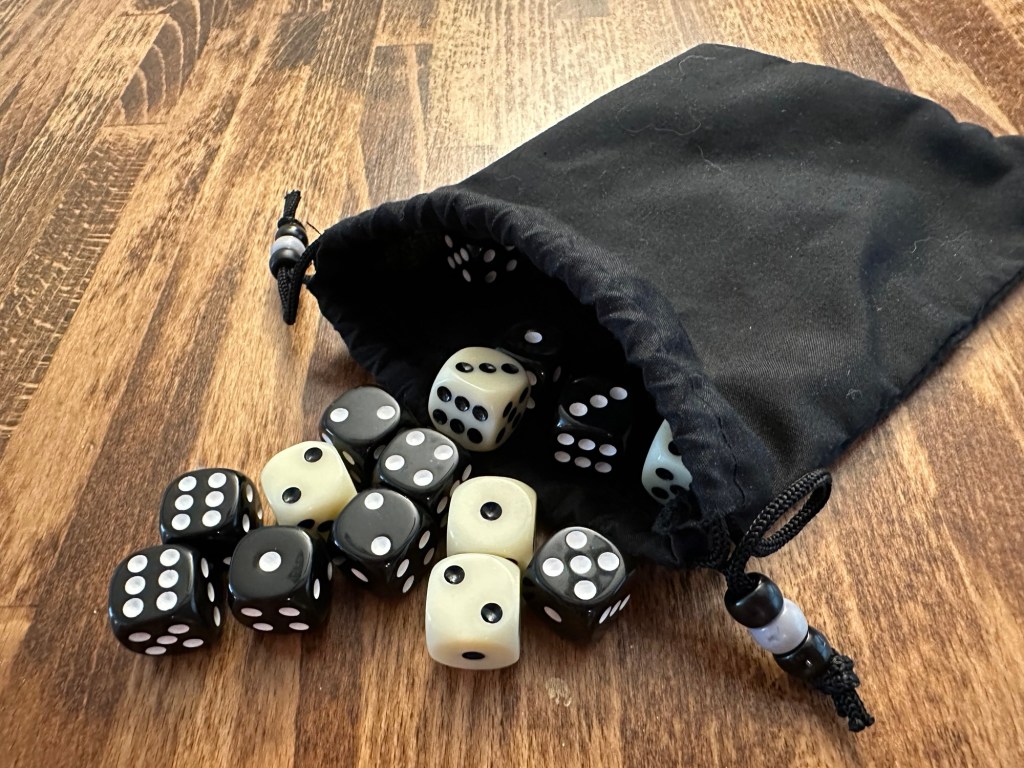
Okay, there’s slightly more nuance to it than that. Most of the dice in the bag are black. Those represent the enemy successfully attacking. Some of the dice are gray (or, in my prototype, off-white; it’s what I had). Those represent an enemy attack failing. Depending on the dice pulled from the bag, sometimes the enemies will have one or more misses coming, and sometimes they’ll be all successes. Which enemies succeed and fail to hit is determined by putting the dice in equal or descending order (black dice come before equal gray dice) on the enemy cards, and if there’s a hero in front of an enemy with a black die, the hero gets hit.
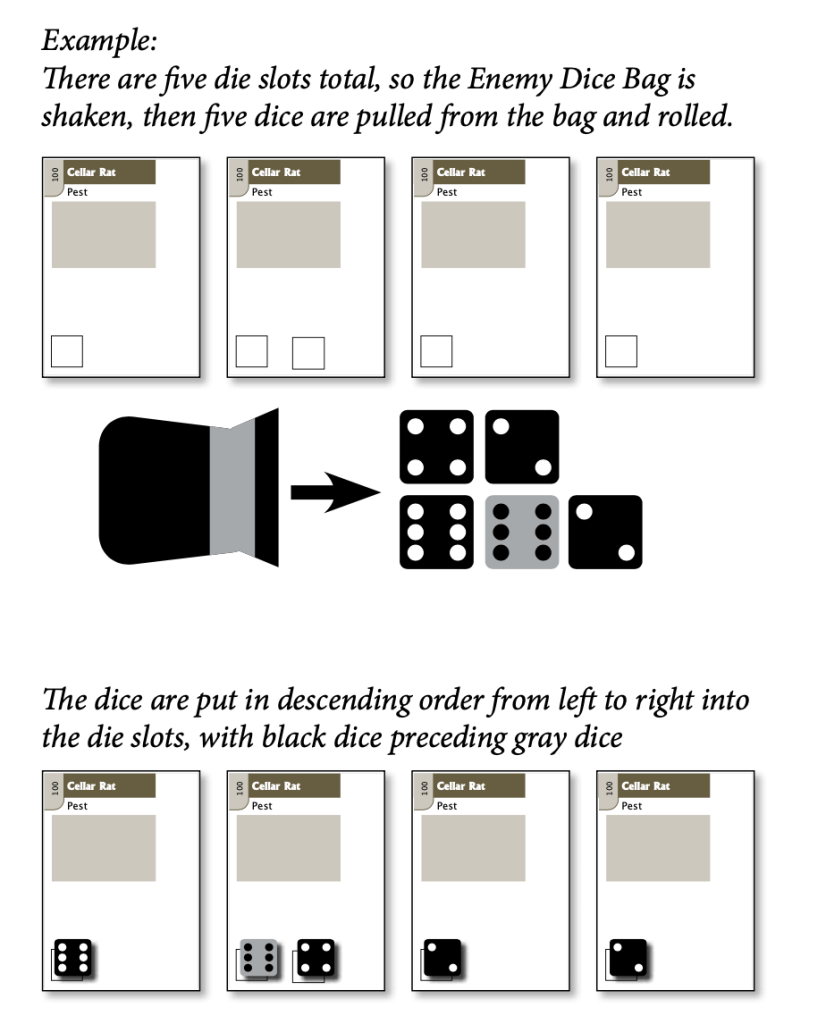
As self-piloting automated game drivers go, it’s about as simple as it gets. One of my earliest goals for this game was for it to be so effortless that my 10-year-old kid could teach his friends how it worked in under a minute, and that it wouldn’t impede actual player decisions or flow. This nailed those marks.
There’s a simple equation for filling the bag with the right assortment of dice: one black die for every die slot (empty die-sized box) on all the enemies combined, and one gray die for every two enemy cards, rounded up. If you can count at all, and you can divide by two (rounding up), you can run the system.
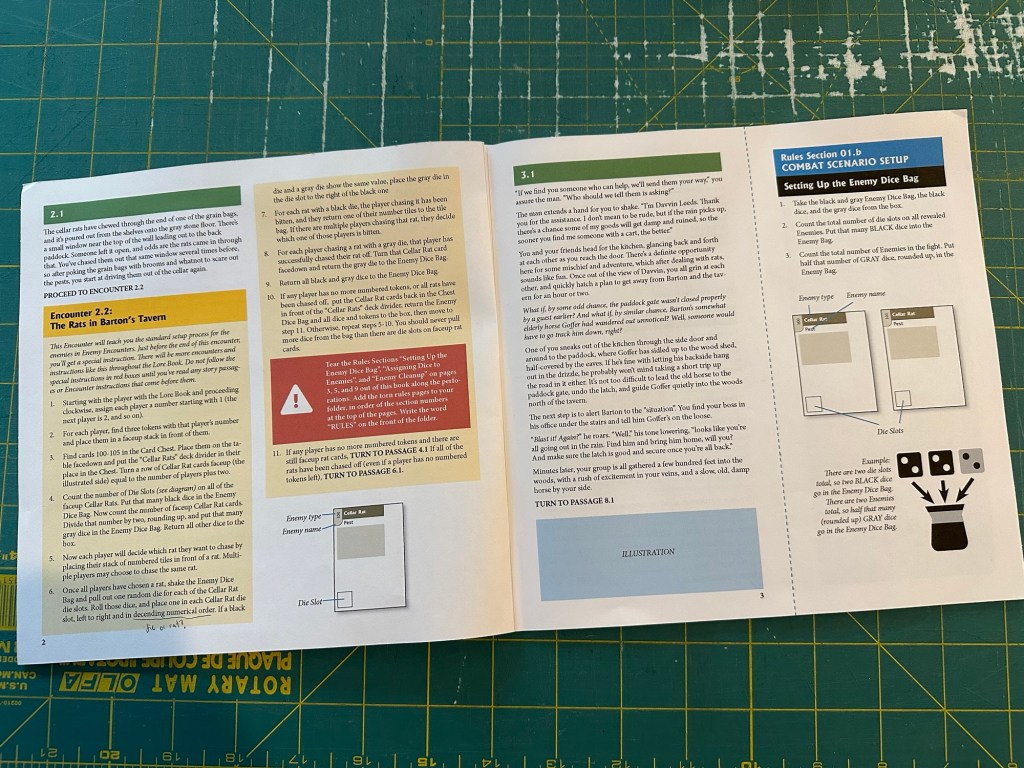
The diagram here comes from a tear-our rules section in the Disco Candybar Lorebook. It’s a piece of the “build-as-you-go” rules folder, and it’s one of the first things you’ll learn in the game. Some experienced gamers have called it too simplistic, and for them, they’re probably right. You pick a rat to stand in front of, and you either get hit —Boo! Little losses! — or you don’t. In the latter case, you chase off the rat. Hooray! Little wins! Either way, all you’re really learning is how every encounter with an active enemy after that will work.
I add more stuff to the system as the game goes on. In the next encounter with active enemies, they start to deal specific amounts of damage to the hero they’re facing when they get a black die. Later, they get bonuses when a black die in one of their die slots shows a specific value. Through the gradual growth in this system, the fights gain depth and richness, with enough randomness to be interesting on replays, and enough predictability (within a spectrum of possible outcomes) that players can make strategic decisions about how to approach the enemies they’re facing.
And there it is. Some of the recipe I’ve been keeping secret for around six months now.
With that, I might as well give you a peek into some of the “actual” printed stuff you’d find in the game box. I say “actual” because this is all prototype and entirely subject to change if and when I move forward with it for further development and/or publisher interests. Which maybe this will spur on. Manifesting good stuff is cool.




PREVIOUS:
Aww, What the Hell
NEXT:
Goldbug Grows
 DiscoCandybar.com
Leave a comment