
Last we spoke, I was opening a bit about dealing with the depression that has come from the general state of the Board game industry. I’m glad to report that I think I’ve found something that helps.
My wife likes to tell our son that sometimes you need to just “eat the frog”, meaning you have to bear down and do the hard or unpleasant thing once and for all, and get past it. Once you’re over that hurdle, the rest can flow.
(She’s also the one who taught me “High/Low/Buffalo”, which has come in really handy many times in my career as a game designer, yesterday included. She’s pretty smart.)
This week, my Frog was a matter of pulling on my figurative boots and putting my games on the table for more playtesters to experience. I’d been wallowing in uncertainty and darkness for around a month, and I needed something to break that pattern. I needed a way to restart the choked creative engines and motivations.
I needed these things. I didn’t initially want them though. If you’ve ever dealt with depression, you’ll know what I’m talking about. Doing anything — even something you’d normally be excited about doing — takes energy, and depression absolutely kills that energy. But that’s what made this my Frog to eat, so I went back to a formula I know I’ve enjoyed in the past.
Step 1: Invite guests.
Step 2: Grill burgers and hot dogs
Step 3: Play games until everyone is drained.
My house has an awesome backyard porch. Lots of good space to sit around, relax, and talk with people. More seating than we’d ever need 98% of the time (we used it all and then some once, and it was great). Despite how bad they can be for me, I love burgers and hot dogs. And when I’m not depressed, I live in a weird “introverted extrovert” headspace. Backyard grilling parties are a big pick-me-up.
They’re also a good way to kick off a solid session of gaming. If I can get that far into the process, the Frog is eaten.
Spoiler: the Frog was eaten.
I had five guests over yesterday. The group included three guys and two women, some board game community content creators, some professional game designers/developers, some parents with kids ranging from elementary school to high schoolers, some heavy “Euro-gamers”, some that enjoy lighter stuff, some that are into solo games, adventure-gamers, fans and non-fans of Role Playing Games, and so on. All in all, a really good cross-section of board game fans, and as it turns out, all people exceptionally good at identifying and explaining what they like and dislike about different games.
We had four games that I wanted to bring to the table:
- Development Build #87, a social strategy game with serious potential for “emergent in-game evolution”, designed by a friend
- Not Candy, a light strategy game with very simple components
- [NAME WITHHELD], a twist on a classic card game with some strategic hooks (“<BLANK>, but for gamers!”)
- Disco Candybar (Prologue)
Apart from one guest who had to leave early (sadly, Disco Candybar was the game they had to skip out before), we managed to get through all four games. And like five burgers, three hot dogs, various sodas, a veggie tray, and two bags of gourmet popcorn.
Overall, the assortment of games provided a solid balance for the day. No two games felt the same, so moving from one to another was a fresh start each time. I think this is an important factor when playtesting multiple games; repetition can make one experience blend into the next, and changing the style, mechanic, or genre helps keep each game feeling distinct. Generally speaking, I wasn’t really looking for players to directly compare one game to another anyway, so seeing the assortment naturally appear as four individual acts was a great thing.
I used the High/Low/Buffalo model to gather my data. For anyone that hasn’t seen me explain this before, here’s a basic rundown.
HIGH
What were the high points of the game? What element did you enjoy the most? What’s working really well?
LOW
What were the low points of the game? Did any parts detract from your experience or need more work?
BUFFALO
What did you see — for better, worse, or neither — about this game that struck you as surprising or memorable?
I’ve found for quite a while now that just getting a playtester to tell you whether you liked a game or asking them for a score doesn’t really give you actionable data, or even start a meaningful conversation. Breaking it down into their favorite, least favorite, and most surprising moments though puts them in a position where they need to give thoughtful, qualitative answers. If they tell you exactly what they liked most — rather than just giving the whole game a “9 out of 10” — you can steer into that and amplify those moments in the game in your next development cycle. Likewise, if you know specifically what made your game a “7” instead of an “8” or “8.5”, you can approach development with very specific things to fix.
For this round of Disco Candybar playtests, I started by asking each player to name some games this one reminded them of. Several of the games and books I’d pulled inspiration from showed up on their lists, so just from that, I feel like there’s good evidence that I’m capturing the vibe of those touchstones. That’s important to me. I want my game to evoke the same energy and bring the same dopamine hits as those other well-known and well-loved experiences. So far, the playtesters are verifying that for me. (Some games that were mentioned: Dungeons & Dragons, Roll Player Adventures, 7th Continent, and the Choose Your Own Adventure books.)
The Highs were, in many ways, what I expected to hear. Setup is easy, gameplay is very accessible, the “jump right in without reading rules” model is innovative and seems to work well. The story itself got some nice compliments, which was especially gratifying since I’m really just hacking my way through it without a ton of fiction writing experience.
Pacing was one of the biggest Lows to come up, and I think I agree. The very first encounter happens within three minutes of the story opening; encounter 2 happens more like fifteen minutes later, and the gap between encounters 2 and 3 is about half that.
Hand in hand with the pacing, the “narrator” role got a bit of side-eye. There’s a lot of reading to be done in Disco Candybar, and while the story seemed to be engaging enough to keep people at the table, having one person do all the reading was a bit much. I think the simplest adjustment there would be to suggest that at the end of each story passage, the Lore Book should be passed to another player.
We found some basic production issues; some typos in the Lore Book, some text showing up on the wrong cards, images in diagrams relinking to the wrong files, etcetera. There were places where I could have been clearer in the scenario instructions, and there was one section where we discovered I’d forgotten to include one of the most important parts of the game setup. (Sometimes you look at something so many times that you start filling in the blank spaces automatically in your head. This was one of those times.)
There were concerns about color blindness accessibility, and I have to admit it’s something I had completely overlooked. Color distinction within the components is a fairly important concept in the game, and I’m really not sure how to fix that particular issue without raising costs for those components. If we ever get back to a point where a publisher would be looking for something like this, maybe I’ll look to them to help figure that all out.
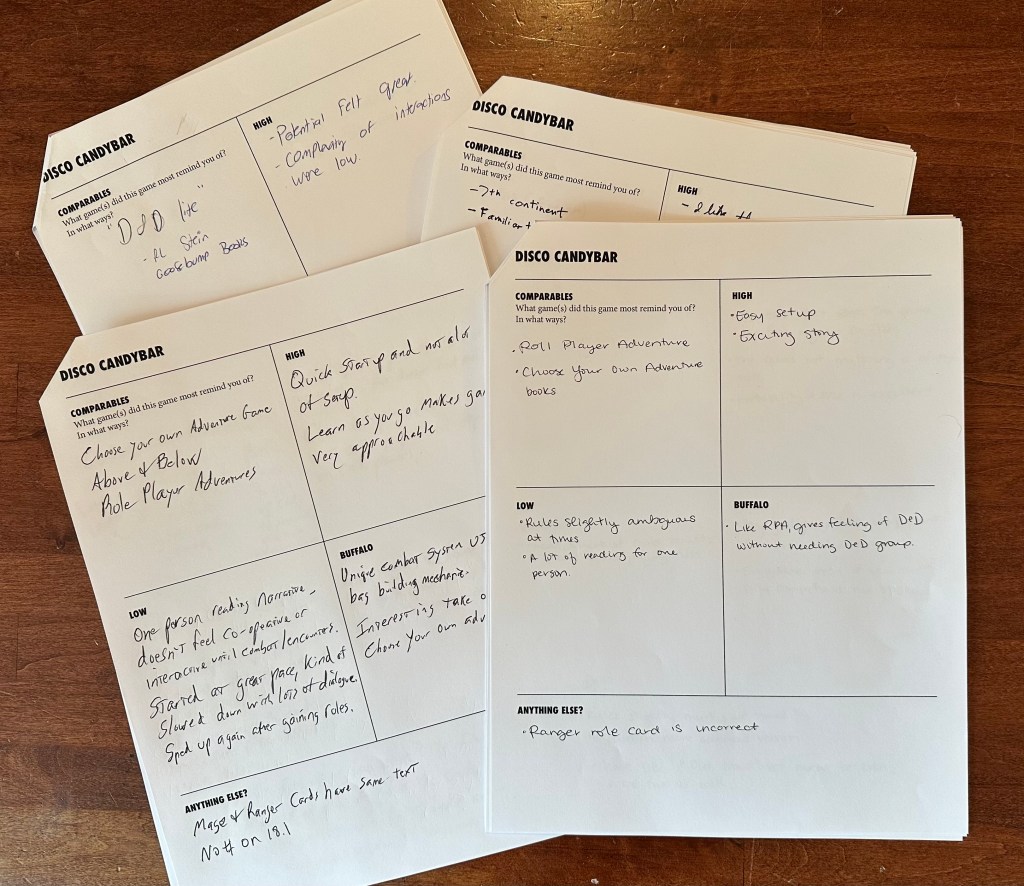
All in all though, the testers had a lot of positive things to say about Disco Candybar, and that showed in their “Buffalo” notes as well. They felt the combat system was unique and easy to get into quickly. Fast setup and teardown were big highlights for some. There was a sense that the game had a “roleplaying-lite” feeling, which most of the players liked. One player noted that, while this game needed the most work out of all the games we looked at (I’ve said before, it’s incredibly ambitious), it probably also had the highest potential among yesterday’s games to be something special and memorable.
I’ll take it. Hearing positive things (even with the low notes) about a project I’d lost some steam on was something my soul desperately needed.
The frog was eaten. Time to carry on.
BONUS CONTENT!
Some notes on “[NAME WITHHELD]” (without giving too much away)…
This is a game I came up with in about five minutes time, and that I spent maybe three hours designing before I first playtested it a week ago at my Friendly Local Game Store. I’ve probably spent more time physically building the prototype than I have developing the game…
…And yet it’s working.
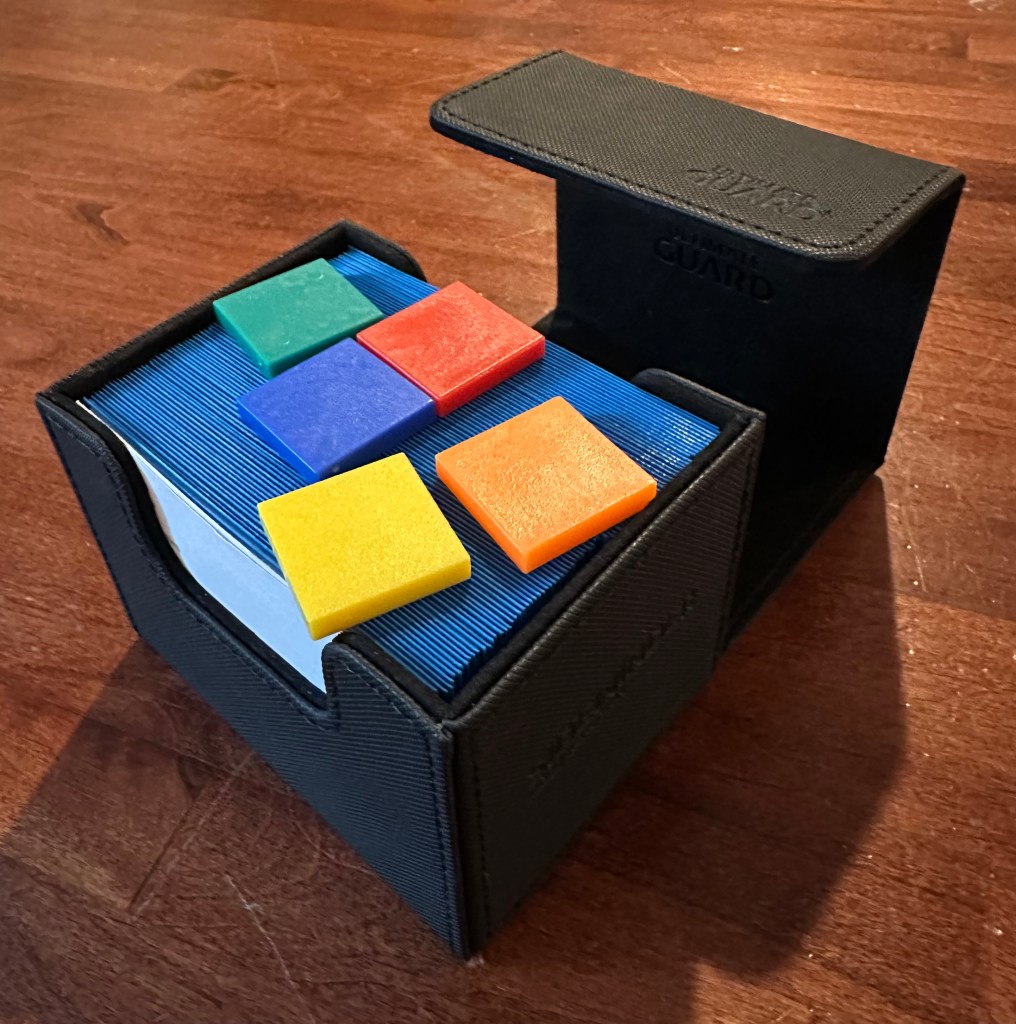
Yesterday in playtests, it got the highest average marks of all of the games we played, and in some cases it wasn’t even close. Multiple people asked me right away if and when it would be available for them to bring to game nights among friends, or to conventions. I was at another table when the first group of playtesters started up a game of it (it currently plays up to four players), and it was hard to focus on our own game with all the excitement and laughs booming from the main table.
As one player put it, it was the game that had the least left to do, and had the highest potential for success in its current form.
So, it would seem, the next step is to get a publisher’s eyes on it — which I’m happy to report is already happening! I’d posted on various social media platforms the other day that one of my games was under review by a publisher; this is the one.
This is really exciting for me. I want to share all the feedback I gathered on this one right here and right now, but I know I shouldn’t. Don’t want to jinx anything that might be happening at the publisher’s end.
PREVIOUS:
Game (and Coping) Mechanisms
NEXT:
Goldbug

 DiscoCandybar.com
Leave a comment