
I live about 45 minutes southeast of Seattle. And while there are plenty of great Friendly Local Game Stores (FLGSs; a general term like “yogurt shop” rather than a specific chain like “TCBY”) in Seattle proper, my preferred FLGS is another 30 minutes southeast of my house. It made for one hell of a Friday-after-work trek when I was working in Seattle proper.
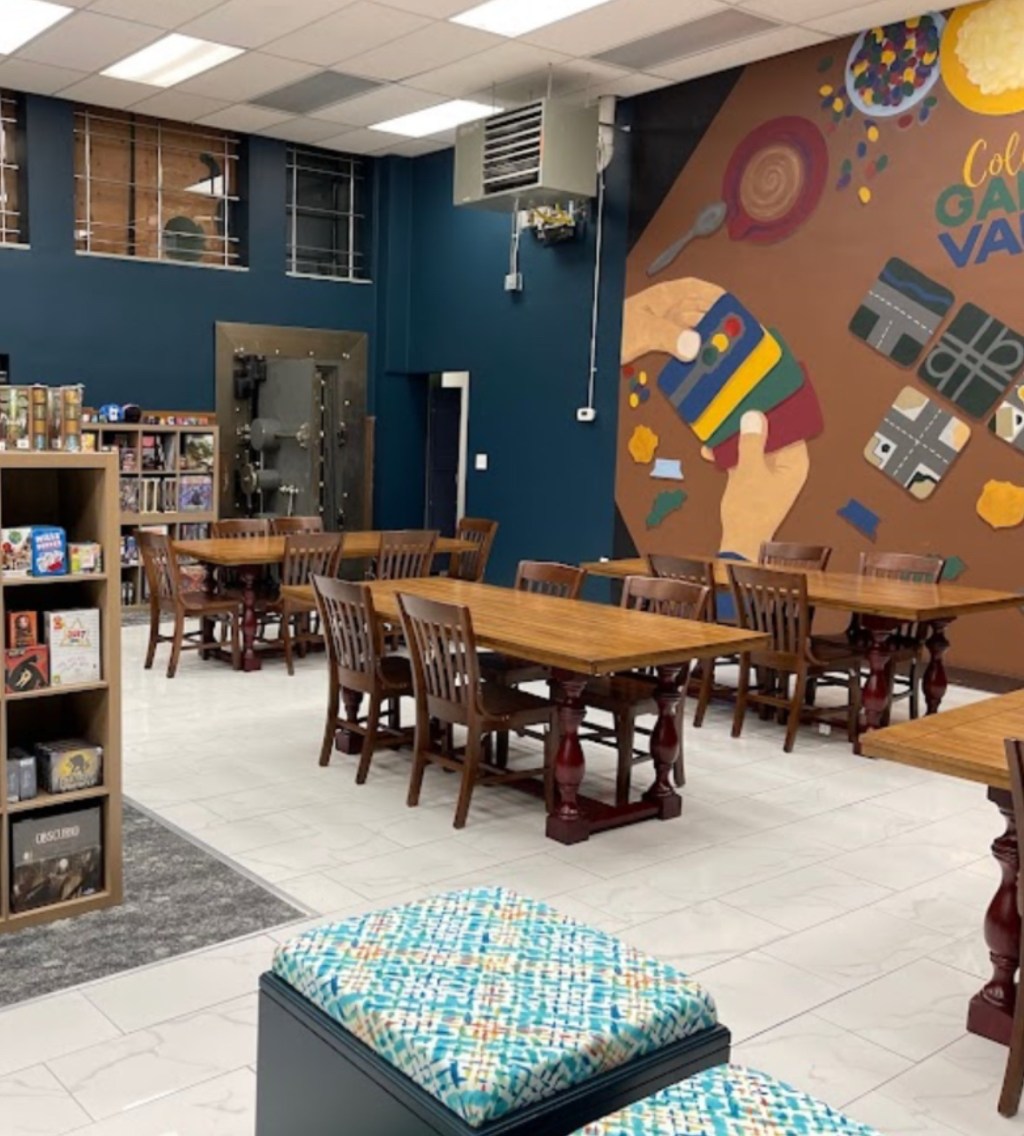
The Cole Street Game Vault is a great mid-sized game shop in Enumclaw, WA. They have a fantastic selection of games, puzzles, and Lego kits. Like many of the best FLGSs, they regularly host various kinds of events for their gaming community (and they’ve fostered a fantastic community). Unlike most stores, they’re located in what was once a literal bank, with an actual early 20th century (or older?) bank vault near the back. It’s full of open board games, like a library, that can be taken out to the tables any time by customers looking to try-before-they-buy. Very iconic and fascinating.

For the last year or so, I’ve been a regular at their Friday Night Magic events, where I draft Magic: the Gathering with a group of roughly a dozen others who try to be there every week. It’s a fun crowd, competitive but very friendly. Lately I’ve been bringing pieces of my physical Disco Candybar prototype with me to the shop so that I can get a few playtests in before the schedule card game begins.
Sometimes when I get there really early, there are curious parties who’ll see me tinkering with components, and they’ll ask to try out whatever it is I’m working on. Other times I’ll just have a short stretch to get some test runs of the combat mechanics and numbers/details with my friend Troy, right before Magic.
This past Friday I went in with a mission: to see how quickly player who’d never played with the prototype could get up and running with the game. My goal is for Disco Candybar to literally be playable within minutes of opening the box. If I can see that experience play out (or not) with people who know little or nothing about my intention, I’ll know I’m hitting my target.
I started with Gary, another one of the regulars whom typically arrives about 15 minutes before the tournaments begin. He’d seen some of the Chapter 1 Goblin encounter play out tangentially, glancing over when Troy and I were playing with it in previous weeks, but never paying so much attention that he knew how it really worked. I jumped him (figuratively) and conscripted him into trying out the Prologue, from the “opening of the box” point. With no explanation other than to just read the Start-Up Sheet, he was off to the races.
There were certainly distractions, as other Magic players were filtering in and greeting each other, but even with split focus, Gary had no trouble getting through the Start-Up instructions and the first few pages of the Lore Book. I piloted the second character, but let him lead the way.
In about ten minutes time, we’d made it past the rats in the cellar of Barton’s Tavern. (Box checked.) We didn’t really get the chance to go further than that, as the main Magic event was about to start, but Gary gave his quick thoughts. “It actually reminds me a little of Buttons and Bugs,” he told me as he immediately produced it from his bag. Buttons and Bugs is a single-player, scaled down (in every conceivable way; it’s literally the size of a coffee mug) version of the Gloomhaven games. (Another box checked, that I wasn’t even expecting.) “The storytelling/gaming mix is there,” he added.
I repacked the prototype in a few seconds. This is another goal of mine; to have something that sets up and packs away extremely quickly. I already knew that would be the case, but as people deep into the gaming hobby will tell you, set up and tear down are both considerable factors when it comes to picking a game to bring to the table.
As the tournament started, we had an odd number of players, and I was assigned a first-round Bye. This meant I had no opponent, an automatic win in the rankings, and roughly an hour to kill. Kellyn, who helps run the shop on Friday nights, has played the Disco Candybar tutorial encounters before, but he was curious about how the Lore Book was working. He asked if he could try it all out, and I obliged. Box was opened, Start-Up Sheet was read, wisecracks were made about how all the tokens were already punched out and bagged; per the meager instructions on the Start-Up sheet, that took about a quarter of the initial experience right off the table.
Once again, even with distractions — he still had to handle customers at the register — he piloted us through the completion of the cellar rats encounter in just under 10 minutes. We talked about how earlier in the day, Danielle Reynolds had pointed out a potential exploit in the first tutorial experience, but Kellyn and I both felt it was pretty minor, and that players who figured it out deserved a little bit of a leg up for the rest of the prologue. He also noted that the “rats in the cellar” trope was pretty common for the first encounter in many beginner role playing games, but again, not a dealbreaker. It’s a low-threat story that doesn’t intimidate new players, and that’s good for this game. More good boxes checked off.
Additionally, Kellyn noted that he was very curious about how the outcome of the encounter impacted the rest off the game. As we all probably did with the original Choose Your Own Adventure books, he kept one finger on page 3 as he flipped back and forth to see what the diverging story paths led to. He smiled, and told me he was really interested in seeing where the narrative portion of the game would go from there.
As Kellyn and I played, Chris, another one of the Magic players wrapped up his games and stopped by the counter to see what was going on. I handed him the Start-Up Sheet, and a minute later he was poking through the bin checking out the components Kellyn and I didn’t already have on the table. He then checked out the first few pages of the Lore Book, which gave him the backstory and explanation of what Kellyn and I were doing. He followed along, and as we wrapped the demo, commented that it felt pretty easy to understand. He thought the absence of a formal rule book was unexpected, but that it seemed to work.
Towards the end of the evening, I finished a Magic match with Chris’s son Nico quickly — a loss for me in the final round — and I asked him if he’d be a guinea pig for a few minutes. He said “sure”, and I put the bin in front of him immediately. The only explanation I gave was that this was the new game I’d been designing and talking about lately, and that it started the moment you opened the box.
Nico seemed eager to jump ahead into the meat of the first encounter. While he read the Start-Up Sheet thoroughly, he blitzed through the opening story paragraphs of the Lore Book, and skipped a few of the steps of the tutorial instructions on page 2. This was a mixed lesson for me; the pitch that this was a “jump in and play” game was maybe too exciting, and the tutorial broke down quickly when just a small portion was missed. When the whole thing takes only a handful of steps to learn, breezing past any of them leaves out a notable percentage of what’s vital.
Beyond this, when I encouraged Nico to carefully read back through the tutorial step-by-step, he was able to guide us through the rats successfully in just under ten minutes from the point where he’d first picked up the bin. The time trial was coming up consistent! I was two-for-two on getting in the first prologue encounter speedily, and delivering the satisfying instant gratification Scott Brady had mentioned a few weeks ago. Add in the slightly skewed time trial with Kellyn, and I had three samples (two and a half?) that all showed similar results.
One last lesson I’m picking up repeatedly now: People really like the name Disco Candybar. It’s 100% NOT going to be the name of the game in the end, but it’s memorable and makes people smile, so at the very least I’m glad I locked in the domain name for this site.
I’m feeling extremely motivated by all of this. Beyond getting encouraging results from the tests I’ve been running, I’m also steadily coming up with the narrative sections I need in order to move the prologue toward Chapter 1’s more robust gameplay and storyline. The file for the Lore Book is filling out well (I also got positive feedback in the layout and look of the Lore Book in general, but I was a graphic designer for years, so if I missed that mark I was definitely doing something wrong). I’m closing in, I think, on having something I can confidently put in front of publishers for official pitches.
Let’s get this thing to the metaphorical — and functional — starting line!
 DiscoCandybar.com
Leave a comment