
As the core mechanics of Disco Candybar have gotten dialed in, I’ve been getting more and more feedback that my overarching goal of making a “jump right in” game was mostly successful, but not quite. There are things that seem to be working, in so far as people lean in closer to hear more when I explain them. There are things that haven’t been testing as smoothly, like the learning curve of jumping right into the Chapter 1 Goblin encounter. All in all, the things I’ve learned from each of my “guest critics” so far has pointed me to creating a prologue before Chapter 1, with very simplified breakdowns of the structure of the Goblin encounter.
Last Monday, I started work on the Lore Book, and ran a somewhat muddled out-of-box playtest with Korby Sears. Between the Lore Book being so new, and the fact that I forgot to bring the first page of it with me to our meeting, the OoB experience didn’t quite work. Since then, I’ve spent a few days refining it.
In the last three weeks, I’ve shown the Disco Candybar digital prototype to around a dozen other game designers and industry pros. The game design community has a lot of interconnections (as you’d expect), so it’s no surprise that several of the people I’ve demoed the game for are good friends with each other, and have even worked together on projects. Early on, I’d gotten Scott Brady to give his thoughts and feedback on my game. A few days ago, I got notes from Whitney Red Loraine. Once I’d spoken to both of them, I knew I had to talk to their good friend and collaborator Danielle Reynolds. Go full circle, so to speak.
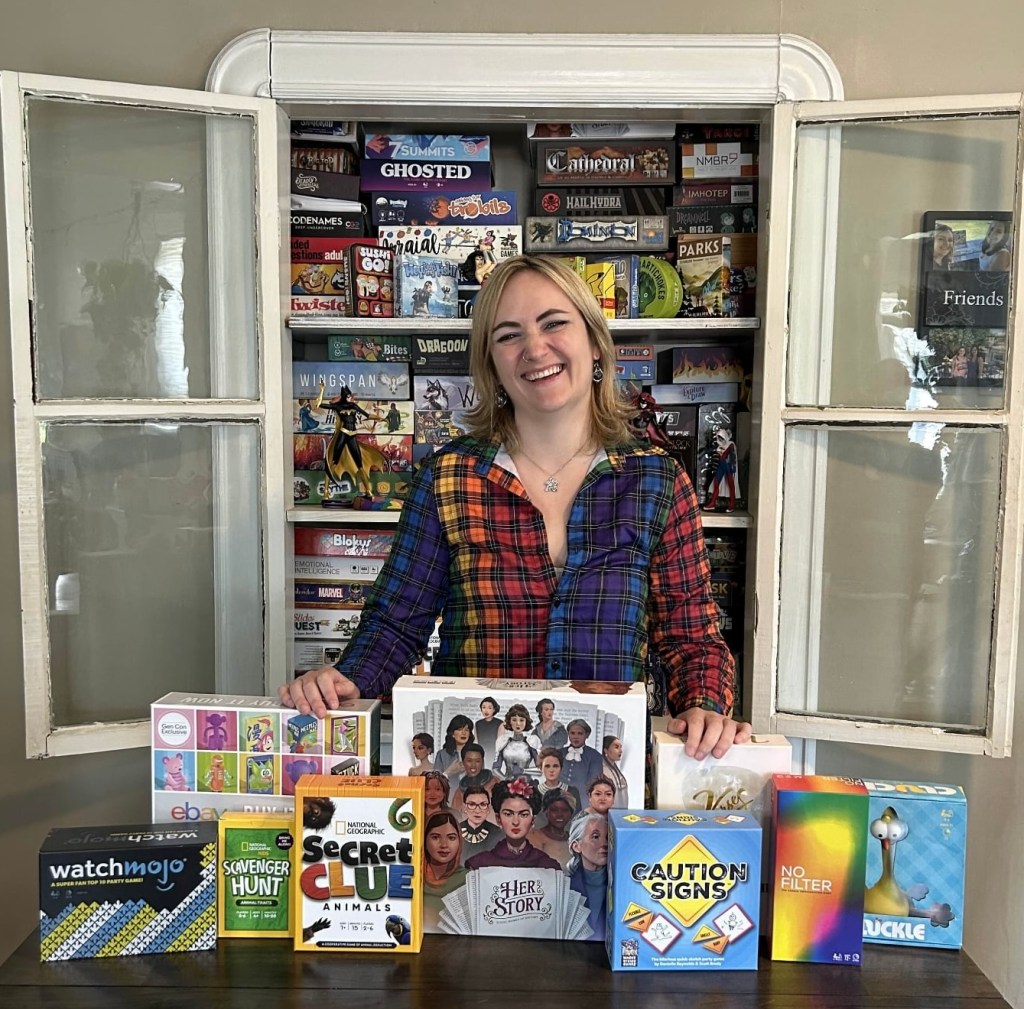
Danielle’s been kicking butt on the game design scene for a few years now. Among her design credits are HerStory, National Geographic: Secret Clue – Animals, the eBay Buy It Now game, and her recent co-design with Scott Brady, Caution Signs. She’s also just got a knack for clicking with people, which only added to my interest in showing her the digital prototype. We’d crossed paths several times at various trade shows while I was at The Op. Now that I’m slowly getting back into board games after a year-plus hiatus, Danielle was someone I just wanted to hang out with for an hour again and talk shop.
I’ve done a lot of Chapter 1 Goblin tests, but only the one semi-out of box test with Korby. To be totally honest, I’m not sure the digital prototype can really capture the intended experience the way the physical version does, but there are obvious mileage limitations to showing off the real thing. My online Tabletopia prototype is much faster to update, and can be demoed for anyone with a desktop computer and an internet connection. It doesn’t include the Lore Book (and the rules therein) though, so it requires me to walk guests through the general story beats and tutorial instructions over the course of our call.
I gave Danielle the standard overview before we launched the prototype. Co-op adventure game designed for families, but particularly with my own 10-year-old son in mind. Mix of narrative choices and gamified encounters. No rulebook.
Right there, there was a look of surprise and curiosity. Maybe some apprehension mixed in.
“You build the rulebook as you play,” I explained. “When you get to certain points in the Lore Book, like at encounters, you get instructions to tear a page out of the Lore Book and add it to a folder. You’re collecting parts of the rulebook one page at a time, so that you never have more to read than you’ve already experienced once through playing those parts of the game itself.”
She still gave me that funny surprised look. “So you’re tearing up your book.”
“Yeah, but it’s totally intentional. The tear-out pages are perforated, so it’s clean.” I don’t know that that was her real concern.
We talked a little about other games that have rulebooks that grow and evolve — “Legacy games” — and how they typically handle it by leaving large sections initially blank. Those gaps get filled in over time with rules text on stickers. I’ve played plenty of games like that, and while it’s an effective method, it still hands a rather large rule book to players right up front, even when a significant portion of that book is blank. There’s a layer of intimidation and distancing from actually playing the game. My proposal was one that dropped the initial weight of the rulebook and the time spent before actually playing to zero.
Danielle nodded and decided to go with it. “Okay then, let’s see the game.”
I fired up the online prototype and we patched her in. After a minute or two of explaining some of the components on the table and setting up the story, we got right to the first encounter. There are rats in the cellar of the tavern, and we’ve got to chase them away. Low stakes, but it teaches players how the enemy AI system works, without cluttering it up with more complex “combat” mechanics. After a single round, she had it.
As we talked a little more about that encounter, I walked her through how the enemy AI sets up much of the player process in future encounters. At one point, she stopped me. Danielle pointed out an element of inconsistency between the way players are assigned damage from the cellar rats and how they’d be assigned damage in all subsequent encounters. “It’ll be confusing,” she said. I ceded that she was right and thanked her for catching it, and made the note to update the rules after the call.
I gave her a little more of the lore; that depending on our level of success with the rats, we’d get different rewards for the task. The story would branch briefly based on that, and then would come back together to follow a single linear path for a little while.
After glossing over the narrative bridge between encounters, we started what I’ve called the “training montage”. The players are shown five small piles of weapons, represented by cards, and each is given instructions to choose one. This choice defines much of their character’s role for the rest of the game.
“Where’s the bow and arrow?” she asked. “I remember playing the video game Gauntlet when I was a kid, and I LOVED the archer.”
There’s no bow and arrow available in those first five character kits. I have one designed for some point in Chapter 1, but for the tutorials, the concepts I needed in order to make a bow feel distinctly different from, say, a sword would be too complex. I assured her that if she took the Ranger (currently dual-wielding a pair of small swords), she’d be rewarded after a few more encounters with the bow she was excited to use. This sounded good to her.
I set us up against a “wooden training dummy” — a basic number dial to count down the dummy’s durability — and showed her how to go about preparing her weapons to deal damage turn-by-turn. Mid way through that part of the demo, she caught a mistake I’d made. It was slightly embarrassing, but we both noted that it meant the system was intuitive enough that she knew when I’d done something wrong.
We proceeded on to trounce the dummy handily. Which we should have, because that encounter doesn’t have any way of dealing the players damage. We’re looking solely at how to use weapons in-game at that point, just like the cellar rats were only teaching us how the enemy AI works. No threat or opposing pressure, just “here’s how this works, and YAY, you win, good job!”
With another short break for a story synopsis (that hasn’t even been written yet), we moved on to the last encounter of the prologue. Wolves have blocked our path back to the tavern, and we need to combine the enemy AI system with our own command of the weapons and combat steps. I talked about a feature that creates some in-game tension around choosing which enemy to face off against. She liked that element, which made me happy, as I’ve had a few people question whether it’s effective enough. I figure that if the feature is pushing different people in different directions fairly evenly, it’s probably just a matter of getting it balanced right, and I can do that over time.
We beat the wolves. The fight wasn’t particularly precarious, but that tells me I need to refine the numbers. Otherwise, it was a perfectly effective tutorial fight, and a solid demonstration of how I anticipate players will learn the foundations of Disco Candybar.
With the last few minutes of our call, Danielle noted that she felt I may be aiming a little low with my age range assessment. “10+ sounds like a kids game to a lot of people, and if your son is a smart kid in a gamer family, he’s probably above the curve for grasping this kind of game anyway. There’s a little bit of math — not much, but it’s there — that 10-year-olds would probably have trouble with. I grew up taking ‘advanced math’ in Arizona and we didn’t start learning basic multiplication until 5th grade (I was 10/11years old) and the other math classes didn’t touch it until the following year. Education is vastly different around the US so age games accordingly. Plus, 12+ is a much safer number that people will read more as a family game than a kids game.”
It’s a good take. Noted. Adjusting how I pitch the game from now on.
One of her favorite parts of the game though was that one she didn’t even get to see. “I’m excited to get a character with a bow and arrow!!” My game allows character customization as you progress through the story, meaning that even if she’d chosen the Thief kit to start with, she’d eventually be able to equip bows. Maybe not as effectively as the Ranger (at first), but she could get there. And that sounded really good to her.
Now I need to finish actually building out the Lore Book, and then format it to work well for online demos. At some point I’d like to start sending the real-world one to publishers for review, and then I’m really going to need a fully-functioning online demo for when the box full of parts isn’t on hand.
More writing. More encounter design. More testing. It’s a big project, but so far every demo’s kept me convinced this is a good game concept.
Woot.
 DiscoCandybar.com
Leave a comment