
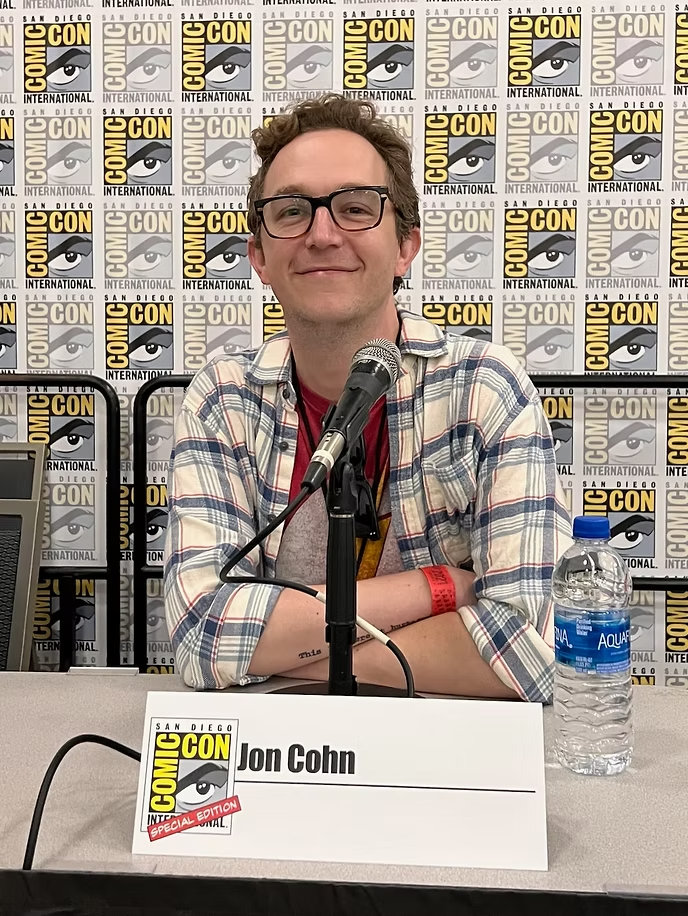
Meet Jon. Jon makes board games and writes horror stories. Lately, he’s been making games about horror movies. Maybe someday he’ll make a horror movie about board games. And then he can write a horror novel about his horror movie about board games. THE CIRCLE WILL BE COMPLEAT.
Jon and I go back a couple of years. He’s another game designer I first met when I started working at The Op Games, but we were both surprised to learn we’d actually worked on a game together even before that. When I’d been working for Forrest-Pruzan Creative around 2017, I’d designed a kids’ game themed around making pizzas. The company that licensed that game from us hired Jon to tune it into a Teenage Mutant Ninja Turtles game. Cut to two years later when I was surprised to see a copy of the game on his wife’s desk in my office, and we all learned of the “small world” connection.
Since then, I’ve had more opportunities to collaborate with Jon on a couple of projects, and it turns out it’s even more fun to work together on stuff when we know each other than when we didn’t. Jon’s just a really likable guy, and our design sensibilities align in a lot of ways.
Case in point, he told me a little about some of his current projects. The biggest takeaway he’s had from designing for his audience is the importance of streamlining and simplifying, so that fans of the stories his games are based on can get straight to the heart of the gameplay as fast as possible.
The heart.
The eviscerated but still-beating, gore covered heart.
Scary stuff.
But he’s absolutely right. For many fans of story-driven games, getting yourself into that story experience is what it’s all about. And while the point of any game is to, well, deliver a distinctly gamified experience, unnecessary complexity in the first few minutes can KILL the vibe.
(Get it? “Kill”? Horror stuff? I’m on a roll.)
On to the Disco Candybar demo.
I shared the lead-up pitch I’ve been delivering for a couple of weeks now. He was on board quickly, noting that he liked the idea of a narrative-driven adventure with quick, simplified battles to add action and tension to the story. We moved on to looking at the game’s enemy AI system.
Disco Candybar may resemble a Role Playing Game in many ways, but when it comes down to it, it’s really not. For one, the game kind of pilots itself. Sure, you get to make a lot of cool, meaningful choices, but there’s no Game Master telling the story or making the decisions for the enemies our heroes encounter. It’s almost as if the game has a mind of its own…
As I’ve said before, the enemy AI in this game is simple. DEAD simple.
Jon’s reaction to the process for determining the enemies’ actions was positive. “This is pretty good. It’s really simplified, and that’s important.” There’s not a lot of extra noise in the system I’ve built, and he liked that. “Still,” he said, “there’s room to simplify it further… It’s got a lot of room to grow into something really big and cool as the story goes on, but for the very first fight players will see, it probably needs to be even less complex.”
It’s a criticism that had come a few times before, and would repeat as a theme in future demos and playtests.
We looked at the hero mechanics, and the message to reduce complexity came up again. As deep-in-the-hobby gamers, we both saw the mechanics as something we’d enjoy and felt comfortable with. Ultimately though, the critique was that if this game was meant to be a self-guided experience without a human teacher there to answer questions, the first choices made by the players had to be even more streamlined. This was a mildly uncomfortable truth for me. I didn’t have an immediate idea for how to keep stripping down the system, and I really didn’t want to start over, throwing out bathwater and my brain-baby.
(I often take these kinds of constructive criticisms to heart pretty hard at first. It usually takes me a few hours, or even a day, to properly chew and digest the message before I can start processing solutions. I’ll get to one eventually, but that’s just how my brain works.)
We talked about the end goal of building mechanics gradually from the start to finish of the game, and he liked what he heard. Character arcs are one of the most engaging pieces of adventure games, and he felt this one had the ability to do it in multiple directions. When I asked him for the “High/Low/Buffalo” review, this was the top thing he listed as a good surprise, and something he’l remember and look forward to in future builds.
Overall though, Jon was excited by what he saw — especially where the potential for story growth lay. As I said at the top here, Jon is a writer. Like Mathew Reuther before him, once Jon heard that the game was narrative-driven, his eyes lit up, and by the end of the demo, he was buzzing with thoughts on how important a good story will be. “If you need anyone to review the written parts, I’m here for that!”, he offered.
I’m no writer by trade, and whenever I can, I leave it to the experts. I’m not a total hack at it either though (I think?), so at some point — maybe soon — I’ll be putting together a narrative outline and some details for the first chapter’s kickoff. Once I’ve got that, Mathew and Jon, expect a call.
But more on that soon.
 DiscoCandybar.com
Leave a comment